
Summarize with AI:
Trading platforms are expanding beyond traditional products, and prediction markets are driving that shift. As more firms look at event-driven markets, the comparison between prediction markets vs traditional trading is becoming harder to ignore.
Traditional trading is built around asset prices. Prediction markets are built around whether a specific event will happen. That difference changes how the market is priced, how it resolves, and how participants engage with it.
For exchanges, brokers, and fintechs, understanding prediction markets vs traditional trading is a necessary step in understanding where this category fits and why it is getting more attention.
What Are Prediction Markets?
Prediction markets let participants trade on whether a specific event will happen, not on whether an asset’s price will move. A participant doesn’t buy Bitcoin or a stock; they take a position on whether a central bank will cut rates by a certain date, or whether a candidate will win an election. The market price at any given moment reflects the collective probability the market assigns to that outcome happening.
That’s what makes these markets structurally different from most trading products. Every prediction market starts with a question, offers a defined set of outcomes, and closes once the event resolves. The market is built around an answer, not an asset, and that single difference changes almost everything about how it works.
Prediction markets can be built around elections, economic data releases, sports outcomes, crypto price milestones, and any other event with a clear, verifiable result. The appeal is straightforward. Instead of reading a chart and guessing how a price might behave over weeks or months, the participant answers one question: Will this happen or not?
What Is Traditional Trading?
Traditional trading is built around assets. Participants buy and sell stocks, commodities, currencies, spot, and crypto derivatives based on where they think prices are heading. The goal might be directional exposure, hedging risk, or capturing short-term price moves, but the underlying object is always an asset with an ongoing market value.
Unlike prediction markets, traditional trading doesn’t revolve around a yes or no outcome. Prices move constantly, responding to earnings, macro data, sentiment shifts, liquidity conditions, and dozens of other signals simultaneously. The market stays open as long as the asset is tradable, which means there is no built-in endpoint.
That breadth is part of traditional trading’s appeal and its complexity. A single asset can respond to earnings, geopolitical news, sector rotation, and macro sentiment all at once. Participants aren’t answering one question; they’re making a layered judgment across multiple variables.
Prediction Markets vs Traditional Trading
The core difference is simple: traditional trading prices assets, prediction markets price outcomes. That single distinction influences how the product is structured, how participants engage with it, and how operators should think about where it fits in their product offerings.
Event-Based Markets vs Asset-Based Markets
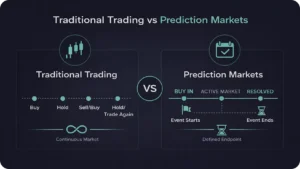
The most direct difference between a prediction market platform and traditional trading is what’s actually being traded. In traditional markets, you’re trading an asset or a contract tied to one. In prediction markets, you’re trading a view on whether something will happen. This makes prediction markets a fundamentally different type of market.
A traditional market centers on the value of Bitcoin, oil, or a stock. A prediction market centers on whether a candidate wins an election, whether inflation exceeds a certain level, or whether Bitcoin reaches a price target by a set date. One market is asset-based, and the other is outcome-based.
This distinction shapes how the market is understood. Asset-based markets are tied to valuation, price movement, and exposure. Outcome-based markets are tied to a defined question and its eventual resolution.
Probability Pricing vs Market Valuation
In traditional trading, price reflects the current market value of an asset or contract. That price is shaped by fundamentals, technical conditions, market sentiment, and broader economic signals.
In prediction markets, the price is the probability. A market trading at 65% means the collective view is a 65% chance the event occurs. Brokers and exchanges don’t need to interpret momentum or valuation, but rather decide on whether they think the market is right or wrong about the odds.
That’s one of the category’s most underappreciated advantages. In traditional trading, price determines where an asset is. In prediction markets, the price reflects what the market believes will happen. Those are very different signals, and for many participants, the second one is easier to engage with.
Defined Resolution vs Ongoing Market Activity
Traditional trading has no natural end date. A trader can hold a position in Apple stock or crude oil for years. The market stays open, and the asset keeps trading. There is no built-in moment where the market closes and a result is declared.
Prediction markets work differently. Every market has a defined endpoint: once the event concludes, trading stops, the market resolves, and payouts are determined based on the outcome. That gives prediction markets a much shorter, more structured lifecycle than most traditional products.
The structure of each market also impacts participation. Traditional markets can support long-term positioning, short-term speculation, and everything in between. In contrast, prediction markets are built around a specific window of time, a specific outcome, and a clear close.
Where Prediction Markets and Traditional Trading Overlap
Prediction markets and traditional trading are different, but they share the same underlying mechanics. Both depend on core market functions that make trading possible and useful.
They both rely on:
- participation
- pricing
- continuous reaction to new information
- active buyers and sellers to keep the market liquid
- participants who can read the situation better than the broader market
In both cases, price is not static. It responds to conviction, demand, liquidity, and changing expectations. Both market types translate market views into price.
That overlap matters because it explains why prediction markets feel familiar to trading businesses even when the product format is new. The core mechanics of market activity, pricing signals, execution, and settlement remain the same. What changes is what the market is actually pricing.
Traditional trading uses those mechanics to price assets. Prediction markets use them to price the likelihood of an outcome. The overlap is real, but the purpose of the market is different.
How Trader Behavior Differs Across Both Models
The structural difference between these models also changes how participants actually behave. In prediction markets, the question is direct, and the decision framework is tight. In traditional trading, participants are constantly interpreting asset behavior, market context, and shifting exposure, often all at once.
Trading a View on an Outcome
In prediction markets, the decision is binary: will this event happen or not? The real question a participant asks is whether the market has the probability right. Is it overestimating the chance of this outcome, or underpricing it? That framing is tight, direct, and easy to reason about.
That clarity makes the format easier to understand, especially for participants who want direct exposure to a defined question rather than broader exposure to an asset class. The trade is still driven by risk and market judgment, but the decision framework is tighter.
This also affects how participants respond to new information. In a prediction market, new information often has a direct relationship to the event in question. That makes the market response easier to interpret because the link between the event and the price is clearer.
Trading Exposure to an Asset
In traditional trading, the participant is managing exposure to price movement, and that’s a more layered problem. A directional view isn’t enough on its own. You also need to be right about magnitude, timing, and the forces that could push the trade sideways, even if your broader thesis is correct. Being right about the direction and still losing on a trade is a common experience in traditional markets.
This makes traditional trading more complex. The opportunity can be larger, but the interpretation is less direct than a market built around a single question. A trader may be right about the broader environment and still be wrong on timing, momentum, or magnitude.
That is one reason these models feel different even when both involve speculation and market judgment. One asks for a clearer answer. The other asks for a more complex read of an asset and its behavior over time.
Why Simplicity Changes Participation
Prediction markets attract attention because the format is easier to read. A participant can look at the market, understand the question, and immediately grasp what the price is saying. That doesn’t make them operationally simple, but it does make the entry point feel more intuitive than most trading products.
For platforms, that matters. Simpler market framing drives broader engagement. It gives participants a way to express conviction without needing to navigate a complex product structure first.
That does not mean prediction markets are always easier to trade well. It means the market premise is easier to understand. For operators thinking about product strategy, that difference matters because accessibility at the market level shapes how quickly participants understand the product and decide to engage.
Why Prediction Markets Are Increasingly Growing
Prediction markets are gaining real traction right now, and the timing makes sense. Most trading platforms are competing over the same products, the same user segments, and the same features. Prediction markets offer something genuinely different: a market format tied directly to events people are already paying attention to, from elections to economic data to crypto milestones.
A Different Type of Trading Experience
Most trading products ask participants to take a view on price. Prediction markets ask them to take a view on what will actually happen in the world. That’s a different kind of engagement, one tied to live events, public information, and the kind of questions people are already debating outside of trading platforms.
This does not make prediction markets better than traditional trading. It makes them different. That difference is exactly why the category is drawing attention. In a product environment where many offerings start to look similar, a different market format matters.
A Complement to Existing Products
Prediction markets do not need to replace spot or derivatives to matter. Their value is that they sit alongside existing products and expand the range of ways participants engage with a platform.
Growth does not always come from improving the same products again and again. Sometimes it comes from introducing a new category that attracts attention differently. Prediction markets should not be framed as substitutes for every traditional product. They should be understood as a distinct addition to the broader trading mix.
This is also where related comparisons like prediction markets vs derivatives become useful. The point is not to collapse these categories into one another, but to help operators understand where each one fits and what each one offers.
A Strategic Option for Exchanges, Brokers, and Fintechs
For crypto exchanges, brokers, and fintech platforms, prediction markets represent a distinct product category with growing visibility. They create room for broader market participation, more event-led engagement, and a different way to think about product expansion.
That is the strategic value. Prediction markets give operators another market model to consider as trading platforms continue to broaden beyond a narrow set of familiar products.
What This Difference Means for Exchanges, Brokers, and Fintechs
For exchanges, brokers, and fintechs, how prediction markets work has direct product relevance. Prediction markets need to be assessed as a real product category within the platform offerings, with clear consideration for what it takes to properly support this trading activity.
Prediction markets are:
- familiar enough to integrate without a complete rebuild
- different enough that they cannot be treated like a small add-on
- distinct from spot, margin, and derivatives in how they function
That matters because operators who treat prediction markets like a simple extension of existing products tend to underinvest in the parts that actually make them work.
The relevance also varies by business type:
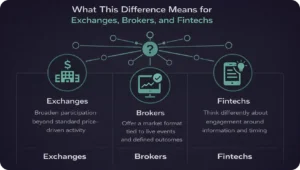
- Exchanges: can use prediction markets to broaden participation beyond standard price-driven activity
- Brokers: can offer a market format tied to live events and defined outcomes
- Fintechs: can use the category to think differently about engagement around information, timing, and market participation
The real question is not whether prediction markets look enough like traditional trading to fit on a platform. The better question is what kind of participation they create, and whether that participation supports the platform’s broader business goals.
Why This Comparison Matters Now
Differentiation is harder than ever because spot and derivatives are no longer differentiators. They are standard product categories. Nearly every serious trading platform offers them, which means competing on the same core products usually comes down to incremental gains in pricing, execution, or fees.
Platforms that want to stand out need more than a better version of what everyone else already has. They need product categories that create a different type of participation.
Prediction markets belong in that conversation because they combine three things that matter:
- a format that is easy to understand
- a market structure that still feels credible to traders
- a direct connection to real-world events that already command attention
That combination gives operators something most standard products do not. It gives them a category that is easier to position, easier to explain, and naturally tied to moments people are already watching.
This is also where many decision makers get the category wrong. Prediction markets are not a repackaged derivatives product. They are not another asset class. They are not a minor variation on a familiar trading format.
They are a separate market model with their own logic, participant behavior, and product implications. Operators who understand that are in a much better position to judge whether the category fits their platform and what it would take to offer it properly.
Final Thoughts
Prediction markets and traditional trading serve different purposes. Traditional trading gives participants exposure to asset prices and market movement. Prediction markets give them a way to trade on whether a specific event will happen.
That difference matters. It shapes pricing, participation, prediction market settlement, and the overall role each product can play on a trading platform. As more exchanges, brokers, and fintechs look for ways to broaden their product mix, understanding this distinction becomes more important.
Prediction markets are not a replacement for traditional trading. They are a different category with different mechanics and a different type of appeal. If you’re evaluating where prediction markets fit within your broader trading platform strategy, reach out to Shift Markets.
FAQs
-
What is the difference between prediction markets and traditional trading?
-
Are prediction markets the same as derivatives?
-
How is pricing different in prediction markets?
-
Why do prediction markets have a fixed resolution?
-
Why are trading platforms interested in prediction markets?
Share this article:
Want to learn more?
Let us save you time by walking you through what Shift can do for your business!