
Summarize with AI:
The growth of prediction markets is being driven by clearer market structure, stronger visibility, and broader interest from participants and operators looking for new ways to engage with markets.
As of 2026, prediction markets have reached $162.65 billion in notional volume, covering 757.6 million transactions and $939.9 million in open interest across the top platforms.
These figures aren’t surprising. Prediction markets provide users with a direct way to take a stance on real-world events, ranging from elections and economic data to sports and cryptocurrency milestones.
Rather than trading an asset, participants trade on whether an event will occur. As a result, this category is easier to understand than most trading products while maintaining the same market structure that adds to its credibility.
For exchanges, brokers, and fintech platforms, prediction market growth is becoming harder to ignore, creating an urgency to include this category in their wider product offerings.
Prediction Markets Are Moving Into the Mainstream
Prediction markets are becoming more visible, more active, and more commercially relevant.
Although volume growth plays a key role, it isn’t the only factor driving prediction markets into mainstream trading. These markets are becoming more prevalent in sectors valued by regulators, media companies, and market operators.
One clear signal came from Google. On January 21, 2026, Google updated its policy to allow ads for prediction markets in the United States, but only for federally regulated entities. Trading categories don’t usually get that flexibility unless these markets have moved into a more established commercial lane.
Another signal came from the regulatory side. In March 2026, the CFTC issued an enforcement advisory tied to prediction markets, specifically event contracts traded on Kalshi. That doesn’t settle every open question around the category, but it proves that prediction markets are being treated as a serious market segment rather than a passing curiosity.
The same shift is showing up in distribution. Fox recently partnered with Kalshi to integrate sponsored crowd odds into news coverage across multiple channels, extending that data to an audience of nearly 200 million people monthly. Again, this highlights that prediction markets are no longer being discussed only inside trading circles. These platforms are moving into broader public visibility.
The Overall Prediction Market Growth
Prediction market growth is now showing up in the numbers, not just in the conversation.
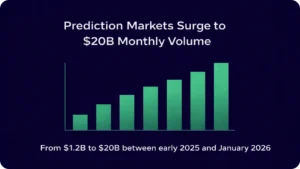
Monthly transaction volume grew from about $1.2 billion in early 2025 to more than $20 billion in January 2026, and monthly participation rose to more than 800,000 unique wallets, with some reporting putting it at roughly 840,000 by February 2026.
What is driving that growth is fairly clear. The format is easier to understand than most trading products, the markets are tied to events people already follow, and the prices update in real time as expectations change.
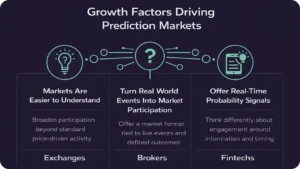
Growth Factors Driving Prediction Markets
These are the most prevalent factors impacting prediction market growth, and what this means for operators adopting this trading category.
Markets Are Easier to Understand Than Many Trading Products
A key factor driving prediction market adoption is because these platforms centre around event-based trading.
Instead of asking participants to evaluate an asset across multiple variables, the market asks a direct question. Will inflation come in above a certain level? Will a candidate win? Will Bitcoin reach a price target by a certain date?
That simplicity lowers the barrier to understanding what the market is asking and what the price means. In most cases, a participant can look at the market and understand the question immediately.
This doesn’t make prediction markets simple in an operational capacity. Operators still have to consider enforcing clear rules, managing user data, and delivering seamless settlements. But from a participant’s point of view, the entry point is clearer than it is in most traditional products.
Operators Can Turn Real World Events Into Market Participation
A second influence on prediction market growth is that this trading activity is tied to moments that already have public attention. These markets don’t need to manufacture interest around the product itself. The interest already exists because the event is already relevant.
For example, a central bank decision, an election, or a major sporting event already has an audience. Prediction markets give the audience a way to express a view through market activity rather than just discussion.
This is also reflected in the mix of activity now driving the category. TRM Labs pinpoint geopolitics, macroeconomics, and politics as the majority of trading activity across prediction market platforms, overtaking crypto native topics as the main driver of volume growth. That is a strong sign that the category is expanding into broader event-based participation.
Platforms Offer Real-Time Probability Signals
Another reason why prediction markets are gaining traction is because trading activity is easy to interpret. In most cases, the price reflects the market’s implied probability of an outcome. If a contract trades at 70 percent, the market is signaling a 70 percent chance that the event will happen.
That pricing model gives participants something direct. The market is not only showing a price; it’s showing what the market currently believes. As new information enters, that view updates in real time.
This makes prediction markets useful beyond participation alone. These platforms also function as live indicators of changing expectations, which is part of why the category attracts attention from both traders and operators.
Delivers a Unique Experience From Standard Trading Products
Most trading platforms already offer familiar product categories. Spot is familiar. Derivatives are familiar. Margin is familiar. Prediction markets feel different because they are built around outcomes rather than asset exposure.
That doesn’t mean they replace traditional products. Instead, these markets bring a different type of market behavior to the platform. Rather than managing an asset position, participants are trading on a view on whether a specific event will happen.
That gives the category its own identity. It’s not just another version of a product people already know; it’s a separate market format with its own logic and its own type of engagement.
Fit the Shift Toward Broader Platform Participation
Prediction markets also fit a broader trend in platform strategy. Trading businesses are looking for ways to broaden participation without relying only on the same core products. Growth doesn’t always come from making existing products slightly better. Sometimes it comes from adding a category that attracts attention differently.
These markets do that well because they are easier to explain, easier to position around live events, and easier to understand at a glance. A category that people can read quickly is often easier to present, easier to market, and easier to place within a broader product mix.
Why Prediction Market Platforms Matter for Exchanges, Brokers, and Fintechs
For crypto exchanges, brokers, and fintechs, prediction markets platforms can broaden participation, create engagement around live events, and expand the product mix without changing the core logic of trading.
A New Product Category With Clear Market Logic
It’s becoming increasingly critical for operators to implement prediction market software and build their own platforms, as trading activity is much easier to understand than many specialized trading products. The market asks a clear question, and the price reflects a clear signal.
Participants don’t need to work through several layers of valuation to understand what is being traded. They need to understand the event, the possible outcomes, and what the market thinks is likely. That is a more straightforward proposition.
For operators, that clarity is useful. A product that is easier to explain is often easier to position within the broader platform offering.
Event Driven Engagement Around Moments People Already Follow
Offering prediction markets creates engagement around moments that already matter. That is a meaningful difference from products that rely on continuous attention to price charts and broad asset exposure.
A political event, a major economic release, or a widely watched crypto milestone already has momentum behind it. These markets give that momentum a market format. Instead of asking people to care about a product first, the market connects directly to something they already care about.
That makes the category easier to connect to public attention, and that has obvious value for firms thinking about participation and product relevance.
A Practical Expansion Beyond Standard Product Menus
Prediction markets should be understood as an adjacent category, not a replacement for spot or derivatives. Their value comes from expanding the range of ways participants can engage with a platform.
Standard product offerings are no longer enough on their own to create a distinct offering. Platforms need categories that feel different, create a different type of participation, and still make sense within a trading environment.
Prediction platforms fit that requirement as they are close enough to familiar trading logic to feel credible, but different enough to stand out.
Final Thoughts
Prediction market growth is rapid in 2026 because these platforms combine accessibility, market-based credibility, and direct relevance to real-world events. They are easier to understand than most trading products, easier to connect to live moments, and easier to position as a distinct category within a broader platform strategy.
For exchanges, brokers, and fintechs, that makes prediction markets more than a passing trend. It makes them a category worth evaluating seriously.
If you are exploring where prediction markets fit within your broader platform strategy, reach out to Shift Markets.
FAQs
-
Why are prediction markets gaining traction?
-
Why are prediction markets growing?
-
What makes prediction markets different from traditional trading?
-
Why are exchanges and brokers paying attention to prediction markets?
-
Are prediction markets becoming mainstream?
Share this article:
Want to learn more?
Let us save you time by walking you through what Shift can do for your business!