
Summarize with AI:
Key Takeaways:
-
Launching a crypto exchange platform in 2026 presents a lucrative opportunity, with the global crypto exchange market projected to grow substantially by 2030, but requires careful planning, regulatory obediance, and a solid technological foundation.
-
Key steps involved in launching a crypto exchange include obtaining necessary licenses, selecting a software provider or developing a proprietary platform, integrating banking and payment solutions, securing liquidity, implementing security measures, and building a strong customer support team.
-
Post-launch, ensuring success and profitability requires continually expanding cryptocurrency offerings, providing competitive trading rates, aggressive marketing, and introducing advanced trading options like leverage and margin trading.
Launching a crypto exchange in 2026 requires a regulatory license, a software foundation, fiat payment infrastructure, a liquidity source, and the security and back office tooling to run the business day to day.
Most operators get to market faster by working with a white label provider rather than building independently, which cuts the typical launch timeline from years to weeks. The global crypto exchange market is projected to grow from $5 billion in 2023 to nearly $12 billion by 2030, and operators who establish a platform now are building into a market with significant long-term upside.
What does it actually take to launch a crypto exchange?
Launching a crypto exchange is not a single decision but a set of interdependent infrastructure decisions that need to be made in the right order. The core requirements are:
- A regulatory license in your chosen jurisdiction
- A software platform, whether built internally or sourced from a white label provider
- Banking and payment integration, allowing clients to deposit and withdraw fiat
- A liquidity source to support trading from day one
- Security infrastructure covering custody, access controls, and incident response
- A customer support function
- Back office tooling to run operations, compliance, and reporting on an ongoing basis
How long this takes and how much it costs depends almost entirely on whether you build the platform yourself or partner with a provider that has already built these components.
What type of exchange should you launch?
The first strategic decision is which type of exchange fits your business model and target audience.
A centralized exchange is managed by a single entity that controls operations, order matching, custody, and compliance. Centralized exchanges offer higher transaction speeds, better liquidity, and a more familiar experience for most users. They are the dominant model for operators targeting retail and institutional traders and are the model this guide primarily addresses.
A decentralized exchange facilitates trading directly between users without an intermediary. DEXs offer improved privacy and security through smart contract-based settlement, but they come with lower transaction speeds, less intuitive interfaces, and a more limited compliance toolkit. They are typically built by operators with specific technical reasons to avoid a custodial model rather than by operators launching a general purpose trading platform.
Most operators entering the market in 2026 choose a centralized model, often with a white label foundation, because it provides the user experience and compliance capabilities needed to compete.
Build vs buy: what is the real difference for crypto exchange operators?
| Consideration | Building Independently | White Label Provider |
|---|---|---|
| Time to market | 12 to 36 months | 4 to 12 weeks |
| Matching engine | Must be built from scratch | Supplied and maintained |
| Fiat payment integration | Requires separate banking relationships | Pre-built or supported by provider |
| Liquidity | Your team sources independently | Provider supports or pre-sources |
| KYC and AML tooling | Must be sourced and integrated separately | Often included or integrated |
| Back office and reporting | Must be built | Supplied by provider |
| Security infrastructure | Full internal responsibility | Shared with provider, battle-tested |
| Ongoing maintenance | Fully internal engineering burden | Shared with provider |
| Upfront capital requirement | Very high | Significantly lower |
| Customization ceiling | Unlimited but costly | High within provider framework |
For most operators, particularly those launching a first exchange or adding crypto to an existing brokerage or fintech business, the white label path provides a faster and lower-risk route to a production-ready platform. Building independently gives maximum long-term control but requires engineering capacity and capital that most teams do not have available at the launch stage.
What licensing do you need to launch a crypto exchange?
Obtaining a regulatory license is the first operational step after deciding to launch. The license you need depends on your chosen jurisdiction and the products you intend to offer.
Jurisdiction selection matters both for regulatory burden and for strategic positioning. Some jurisdictions offer crypto-friendly frameworks with clear licensing paths and reasonable timelines. Others impose heavier requirements, longer approval processes, or restrictions on which services are permitted. Operators should select a jurisdiction that aligns with their business model and target client base, not just the easiest path to a license.
Once a jurisdiction is selected, the licensing process involves regulatory filings, compliance documentation, capital requirements in most cases, and, in many jurisdictions, an assessment of the technical and operational capabilities of the platform.
Engaging legal advisors who specialize in crypto regulation in your target jurisdiction early in the process reduces delays and avoids compliance gaps that can slow or block approval.
How do you choose the right software provider for your exchange?
Selecting a software provider is the most consequential technology decision you make. The provider’s platform determines what you can offer, how quickly you can launch, and how much ongoing engineering resource you need to dedicate to maintaining the product.
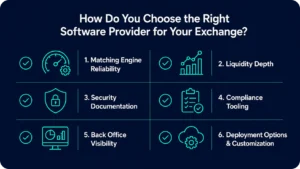
When evaluating providers, assess each of the following areas before committing:
- Matching engine reliability. Can the platform handle your expected volumes without degradation? Ask for performance data and references from operators running comparable volumes.
- Liquidity depth. Validate the depth, spreads, and uptime of the provider’s liquidity integrations through a demo or pilot, and make liquidity expectations explicit in any contract.
- Security documentation. Ask for proof points such as role-based access controls, custody architecture, withdrawal approval workflows, penetration testing results, and incident response procedures.
- Compliance tooling. KYC, AML screening, transaction monitoring, and audit trail capabilities should be integrated into the platform, not sourced separately.
- Back office visibility. Operations and support teams need full visibility into accounts, balances, payments, and trading activity inside a single environment.
- Deployment options and customization. Understand what can be customized within the provider’s framework and what requires engineering work on your side.
What fiat payment infrastructure does a crypto exchange need?
Fiat payment integration is what allows clients to deposit money from their bank and withdraw it when they exit. Without it, the exchange is a closed system that most clients will not trust with real funds.
Fiat payment infrastructure for a crypto exchange covers bank transfer support via SEPA, ACH, or SWIFT, card payment processing for faster funding, open banking integrations where available, AML and compliance screening on inbound and outbound payments, and the settlement and reconciliation workflows that connect payment activity to back office reporting.
Building fiat payment capability independently requires direct relationships with acquiring banks, which are difficult to establish for a new crypto platform. Working with a provider that has existing banking relationships and pre-built payment integrations accelerates this significantly. For operators adding crypto derivatives or other products alongside a spot exchange, having fiat payment infrastructure from the same provider as the exchange platform simplifies the compliance and reporting layer.
How do you source liquidity for a new crypto exchange?
Liquidity determines whether clients can execute trades at reasonable prices without significant slippage. A new exchange with no liquidity is effectively unusable, which means the liquidity strategy needs to be in place before launch, not after.
The two primary approaches are sourcing liquidity through direct relationships with a liquidity provider and working with a white label platform provider that pre-sources liquidity as part of the platform. The second approach is faster and removes the complexity of negotiating liquidity agreements independently, but operators should validate the depth, spreads, and uptime of the provider’s liquidity before committing.
For operators who want more control over their liquidity model, working with a provider that offers market-making technology alongside the exchange infrastructure allows the operator to manage their own liquidity over time as volume grows.
What security infrastructure does a crypto exchange require?
Security is one of the areas where exchange operators face the highest consequences of failure. A security breach affects client funds directly, damages the platform’s reputation permanently, and in most jurisdictions triggers regulatory obligations.
The core security requirements for a crypto exchange include multi-factor authentication for all user and admin accounts, encrypted communications and data storage, cold storage for the majority of client assets, role-based access controls that limit what each admin can do within the back office, a defined incident response process, and regular security audits and penetration testing.
Working with a white label provider that maintains these standards as part of the platform removes the need to build and validate each component independently, but operators should review the provider’s security documentation rather than assuming these controls are in place.
What does the crypto exchange launch process look like step by step?
| Step | Action | Key Decisions |
|---|---|---|
| 1 | Establish your business entity and prepare your business plan | Jurisdiction, corporate structure, capital requirements |
| 2 | Select your jurisdiction and engage regulatory advisors | Licensing path, timeline, ongoing compliance obligations |
| 3 | Choose a software provider or begin internal development | Build vs buy, platform capabilities, integration requirements |
| 4 | Integrate fiat banking and payment infrastructure | Payment methods, compliance layer, onboarding flow |
| 5 | Secure a liquidity source | Direct relationships vs pre-sourced, depth and spreads validation |
| 6 | Implement security infrastructure | Custody model, access controls, audit preparation |
| 7 | Build your customer support function | Coverage hours, tooling, escalation procedures |
| 8 | Test, obtain regulatory approval, and launch | Pre-launch testing, regulatory sign-off, go-to-market |
| 9 | Expand post-launch: new pairs, derivatives, Earn products | Revenue diversification, user retention, product depth |
How do you set up an exchange for profitability after launch?
Launching is the starting point, not the finish line. Sustaining a profitable exchange in 2026 requires ongoing attention to four areas.
Asset coverage
Continuously expanding your list of supported cryptocurrencies and trading pairs keeps the platform relevant and attracts traders looking for access to emerging assets. Platforms that stay current with market trends generate higher trading volumes than those with static asset lists.
Competitive fee structure
Fee levels are one of the primary reasons traders choose one exchange over another. Operators should model their unit economics carefully and price fees to attract volume while maintaining sustainable margins. High-volume traders in particular are sensitive to maker and taker fee structures.
Product depth
Operators who add crypto derivatives alongside spot trading attract more sophisticated traders and generate significantly higher fee revenue per user through leveraged volume. Earn and yield products extend the revenue model further by generating income on assets held on the platform.
Marketing and distribution
Post-launch marketing needs to be consistent and targeted. For operators with an existing FX or fintech client base, the most efficient path to early exchange volume is converting existing clients rather than acquiring new ones from scratch.
How does Shift Markets help operators launch a crypto exchange?
Shift Markets provides a white label crypto exchange platform built for operators who need to launch quickly and operate reliably. The platform covers the matching engine, fiat payment infrastructure through CryptoPay, liquidity integrations, back office and compliance tooling, and security infrastructure as an integrated stack rather than separate components requiring individual integration and maintenance.
Operators who want to add product depth from launch can combine spot trading with crypto derivatives, Earn and vault products, and prediction markets within the same platform environment. Over 125 white label platforms have been launched on the Shift infrastructure, with more than $200 billion in combined trading volume processed.
For FX brokers and fintech operators adding crypto to an existing business, the integration path connects to existing account structures and client data rather than requiring a separate platform with its own onboarding and funding workflows.
Bottom Line
Launching a crypto exchange in 2026 is more accessible than it has ever been, but still requires a regulatory license, a reliable software foundation, fiat payment infrastructure, liquidity, security, and the operational tooling to run the business compliantly from day one.
Most operators get to market faster, at lower cost, and with less technical risk by working with a white label provider than by building independently.
Request a demo to see the Shift platform in action and understand what launching a crypto exchange with the right infrastructure looks like in practice.
FAQs
-
How long does it take to launch a crypto exchange?
-
How much does it cost to launch a crypto exchange?
-
Do you need a license to launch a crypto exchange?
-
What is a white label crypto exchange?
-
What is the difference between a centralized and decentralized exchange?
-
What revenue streams does a crypto exchange have?
-
What happens if you run an exchange without enough liquidity?
-
How do crypto exchanges handle compliance and AML?
Share this article:
Want to learn more?
Let us save you time by walking you through what Shift can do for your business!