
Summarize with AI:
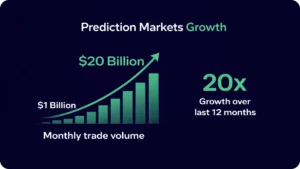
Prediction markets are gaining traction. As trading platforms look beyond spot and derivatives, more firms are paying attention to how prediction markets work and why they are becoming a relevant new category.
Instead of trading assets, participants trade on outcomes. Prices move based on what the market believes is likely to happen, whether that is tied to an election, an economic release, a sporting event, or a crypto milestone.
The model is simple on the surface, but the mechanics behind it matter. Pricing, market structure, settlement, and resolution all shape how prediction markets function and whether they can operate credibly at scale.
For exchanges, brokers, and fintech platforms, understanding how prediction markets work is the first step toward understanding why the category is getting more attention.
What Is a Prediction Market?
A prediction market is where participants trade on the outcome of a future event, not the price of an asset. Instead of asking whether Bitcoin, gold, or a stock will go up or down, prediction markets ask a specific question tied to something that will actually happen. The price reflects how likely the market thinks that outcome is.
These markets are often built around elections, macroeconomic releases, sports results, crypto milestones, and other events that can be resolved clearly once the outcome is known.
What makes prediction markets distinct is their structure:
- a defined question
- a set of possible outcomes
- a clear point where trading ends
- a clear process for settlement to begin
In a traditional market, participants juggle a lot at once, such as price action, sentiment, liquidity, macro pressure, timing, and momentum. In a prediction market, the question is simpler. Will this happen or not? The price is just the market’s running answer.
For exchanges, brokers, and fintechs, that difference is worth paying attention to. Prediction markets aren’t just another instrument. They’re a different format entirely, one built around event resolution rather than ongoing asset exposure. These markets are also easier to explain to a general audience, which matters when you’re trying to grow your user base beyond core traders.
How Prediction Markets Work
Prediction markets move through a clear lifecycle. A market is created around a defined event, participants trade based on what they think will happen, prices move as sentiment changes, and the market settles once the result is known.
Market Creation
Every prediction market infrastructure starts with a clearly defined question. The question must be specific enough that its outcome can be verified once the event ends. If the question is vague, settlement becomes harder to defend, and trust erodes fast.
Good prediction markets are built around measurable outcomes and clear timeframes so participants know what they’re trading, and the platform can settle without complication.
This stage is critical. A market only works when participants know exactly what’s being asked, what counts as a valid result, and when that result gets confirmed. Loose language or unclear timing moves the uncertainty away from the event and onto the rules themselves, which is a harder problem to fix.
For operators, this is one of the first places where market quality is decided. A well-structured market gives participants clarity from the start. A poorly structured one creates confusion that no amount of explanation can fully fix.
Trading Begins
Once the market is live, participants take positions based on their view of the outcome. A trader who believes the market is underestimating the likelihood of an event may buy; one who thinks the probability is overstated may sell or maintain the opposite position.
This is what separates a prediction market platform from opinion polls. Participants express their views through actual trades, which gives the market a mechanism for discovering consensus in real time.
The key difference is accountability. Anyone can answer a poll without consequence. In a market, you put money behind your view, which tends to sharpen how seriously people think before committing.
It also changes how information moves through a market. When something new comes out, participants don’t just react to it; they trade on it. That’s why prediction markets are often watched as live gauges of shifting expectations.
Prices Move With Demand
As traders enter and exit positions, prices adjust continuously. When confidence in a particular outcome grows, prices move higher. When it weakens, prices fall. The price doesn’t represent the value of an asset. It reflects the market’s current estimate of probability. That’s why prediction markets are often used as live forecasting tools. They aggregate sentiment, react to new information, and update as conviction changes.
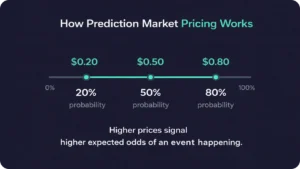
In most prediction markets, price maps directly to probability. A contract trading at 70% means the market collectively puts a 70% chance on that outcome. There’s no valuation model to decode, no earnings multiple or macro overlay to interpret. The price answers how likely an event or outcome is to happen.
However, price quality depends on market conditions. Thin participation can distort signals while strong participation sharpens them. That’s one reason crypto market making still matters even in a simpler format.
Market Resolves
When the event concludes, the market is resolved according to predefined criteria. The platform determines which outcome occurred based on an agreed resolution source, then closes the market and finalizes settlement. Resolution is what gives the market credibility. Without a clear endpoint and a trusted process for confirming the result, the market can’t function as a reliable product.
This is where prediction markets differ from most other formats. The market isn’t meant to run indefinitely. It’s built to end. That fixed endpoint is central to how the product works.
The closer a market gets to resolution, the more important the rules become. Participants need to know what source determines the outcome, when the market closes, and how disputes are handled if questions arise.
Payouts Are Distributed
After the outcome is confirmed, payouts go to participants whose positions matched the result. The platform has to verify the outcome, apply settlement logic correctly, and close the market without errors.
In these markets, settlement quality is equivalent to product quality. Traders remember when a market closes cleanly, and even more when it doesn’t. A platform that handles this well builds trust. A platform that treats settlement as an afterthought puts that trust at risk.
How Prediction Market Pricing Works
In most cases, the price of a contract signals the market’s implied probability of an event occurring. A market trading at 70% suggests the market collectively sees a 70% chance that the outcome will happen. As new information enters and trading activity shifts, the price moves with it.
The contract price is a live read on collective belief. It updates in real time as participants act on new information.
In practice, prediction market prices can change quickly when fresh information arrives. A new data release, a public announcement, a major event, or a sudden shift in sentiment can move the market because participants immediately reassess the likelihood of the result.
This is also where prediction markets start to matter for platform operators, not just participants. A clearer pricing signal makes the category easier to explain and sell. Products people can understand at a glance are easier to grow.
For operators thinking about market quality, liquidity, and execution still matter. The quality of participation shapes how useful that price signal becomes.
How Prediction Markets Are Settled
Settlement is where open speculation becomes an outcome. Once the event concludes, the platform verifies the result using a predefined source and closes the market accordingly. That source could be an official result, a published economic data release, or another agreed benchmark, depending on the market type.
A reliable prediction market settlement process depends on a few things being clear from the start:
- The source used to confirm the outcome
- The point at which the market officially closes
- The standard used to resolve the event
- The process followed if the outcome is delayed or disputed
If any of those points are unclear, trust takes a hit. Settlement rules need to be locked in before trading opens, not figured out after the fact. Ambiguity at resolution is where trust breaks down fastest.
From a platform perspective, this is one reason prediction markets require solid infrastructure, even though the user experience looks straightforward. A market only works if participants trust the rules, the data, and the outcome.
Operators also need to be honest about what they are selling. The appeal of prediction markets is their simplicity, but that simplicity sits on top of rules that have to hold up under pressure. A prediction market is only as reliable as its resolution process.
Prediction Markets vs Traditional Trading
Prediction markets and traditional trading differ in what participants trade and in how markets are structured. Traditional trading centers on price movements of assets, while prediction markets focus on trading outcomes of future events.
Event Based vs Asset Based
Traditional crypto trading focuses on assets, such as crypto, equities, commodities, and derivatives. Prediction markets focus on whether a defined event will happen. The participant isn’t trading ownership or exposure to an asset. They’re trading the expected outcome of a specific question.
This makes a prediction market platform easier to understand at a glance while also setting the foundation for a wider range of market types tied to politics, macro events, sports, or crypto milestones.
Probability Pricing vs Price Speculation
In traditional trading, price reflects what the market thinks an asset is worth right now. In prediction markets, the price reflects how likely something is to happen. That’s a different mental model, and it changes how participants engage with the product. Prediction markets tend to feel more direct because the question is concrete.
Fixed Resolution vs Ongoing Market Activity
Traditional markets are ongoing. Prices move, positions stay open, and there is no built-in finish line tied to a single outcome.
A prediction market infrastructure works differently. Each market is built around a defined endpoint. Once the event is resolved, trading stops, and payouts are determined based on the confirmed result.
That shorter lifecycle changes the experience. It gives prediction markets a clearer arc, from market launch to resolution, and creates a different kind of engagement than ongoing spot or derivatives activity.
Why Prediction Markets Matter for Trading Platforms
Prediction markets matter for trading platforms because they introduce a different market format, one built around event outcomes rather than asset exposure.
Product Differentiation
Most trading businesses are competing on the same products, such as spot, derivatives, etc. Differentiation gets harder the more crowded that space becomes. Prediction markets offer a different angle, one built around participation tied to actual events rather than asset exposure.
This is valuable for operators already thinking about how to broaden their product mix because they can create a market format that feels distinct, is easy to explain, and gives participants another reason to engage with the platform.
Event Driven Engagement
Prediction markets naturally connect trading activity to real-world events. That gives platforms a way to capture attention around moments already driving interest across news, economics, politics, sports, and crypto.
That matters because prediction markets are easier to frame around moments people are already interested in. Instead of relying only on ongoing asset exposure, platforms can offer markets built around timely events that naturally pull attention and encourage participation.
Category Expansion for Exchanges, Brokers, and Fintechs
Prediction markets are a practical extension for crypto exchanges, brokers, and fintech platforms, not a full reinvention of their model. For many operators, category expansion starts with determining what they can introduce through existing infrastructure and where a new market type fits within the broader platform offering.
Prediction markets become the obvious solution because they offer a distinct category with clear mechanics and a unique participation model, while sharing similarities to familiar trading formats.
Final Thoughts
Prediction markets are built around one question with a knowable answer. Participants trade what they believe, prices move as this belief shifts, and settlement closes once the result is known.
For exchanges, brokers, and fintechs, these markets offer a new way to think about participation, product mix, and engagement around live events. If you’re exploring where this category fits within your broader trading strategy, reach out to Shift Markets to continue the conversation.
FAQs
-
How do prediction markets work?
-
How is pricing determined in prediction markets?
-
How are prediction markets settled?
-
Are prediction markets the same as traditional trading?
-
Why are trading platforms interested in prediction markets?
Share this article:
Want to learn more?
Let us save you time by walking you through what Shift can do for your business!