

Summarize with AI:
Prediction markets for brokers are becoming a significant growth category as trading platforms find new ways to drive engagement, trading volume, and client retention. Unlike traditional products that focus only on price movement, prediction markets let clients trade on real-world outcomes across sports, crypto, macro events, elections, and culture.
Launching this category requires more than a new product layer. Brokers need prediction market infrastructure to support liquidity, settlement, compliance, integrations, reporting, and operational oversight from day one.
Why are brokers looking at prediction markets now?
Brokers are paying attention to prediction markets because retail users want to trade beyond charts. These participants are following news cycles, sports events, crypto milestones, central bank decisions, political outcomes, and market narratives in real time. Prediction markets turn that attention into tradable activity.
For brokers, that creates a new way to bring clients back into the platform. Instead of waiting for market volatility, platforms can create activity around events people are already watching and discussing.
This matters because trading platforms are becoming more competitive. Brokers are adding more asset classes, more 24/7 products, and more ways for clients to engage. Prediction markets fit directly into that shift.
These platforms give brokers a way to expand beyond traditional FX, crypto spot, CFDs, and derivatives with a product format that feels immediate, simple, and tied to the real world.
Who are prediction markets relevant to?
Prediction markets are relevant for brokers and trading operators that already have an audience, an active client base, and demand for new product formats.
This includes:
- FX brokers looking to add event-based trading.
- Crypto exchanges are expanding beyond spot and derivatives.
- Multi-asset platforms building broader trading experiences
- Regional brokers serving audiences with specific market interests
- Fintech operators looking for new engagement products
- Platforms that want branded prediction market access without building from scratch
The strongest fit is usually with brokers that already understand trading operations and want to add a new layer of activity to their existing platform. Prediction markets should sit within the broker’s broader trading environment, client journey, reporting structure, and operational model.
What should brokers look for before launching prediction markets?
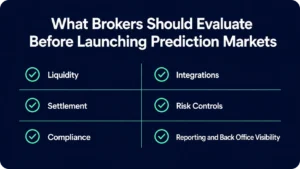
Brokers should evaluate a prediction market platform across the full operating model, not only the user interface.
A strong provider must support:
- Liquidity access
- Settlement and resolution rules
- Compliance-aware workflows
- Integration with existing systems
- Risk management controls
- Reporting and back-office visibility
- Market creation flexibility
- Launch support
- Vendor control maturity
Operators often underestimate prediction markets by focusing only on the client view. The underlying infrastructure must handle pricing, activity, settlement, compliance, controls, and reviews. The right prediction market software for brokers should help the platform move faster without creating unnecessary operational risk.
How should liquidity work in a prediction markets platform?
Liquidity determines whether prediction markets feel active, fair, and tradable.
If liquidity is thin, clients may struggle to enter or exit positions at reasonable prices. That creates a poor experience and weakens trust in the product.
Brokers should evaluate whether the platform can support different liquidity models, including:
- External liquidity connections
- Flow offsetting
- Direct market making
- Custom market creation
- Liquidity support for niche or regional markets
The right model depends on the broker’s goals.
Some brokers may want the fastest path to market by connecting to external liquidity and offsetting flow, while others may want more control over pricing and economics by making markets directly. On the other hand, some operators prefer to create their own prediction markets around specific sports, crypto, macro, political, or regional events.
There is no single right answer. What matters is that the platform can support the broker’s current model and future growth.
How should settlement work for prediction markets?
Settlement is one of the most important components of a prediction market platform.
Every market needs a clear question, a defined outcome, and a trusted source of truth before it goes live. If the result is unclear, delayed, disputed, or poorly handled, clients lose trust quickly.
For price-based events, the source of truth might be an exchange price, index, benchmark, or oracle at a specific time, while sports outcomes may be tied to the official league result or a recognized data provider.
Brokers should ask:
- What source decides the outcome?
- Are settlement rules defined before launch?
- Can settlement be automated where possible?
- What happens if a result is delayed or disputed?
- Are settlement records visible and auditable?
- Can operations and compliance teams review outcomes?
Prediction markets only work if users trust the resolution process, so settlement should never feel improvised after the event ends.
What compliance considerations should brokers review?
Depending on the jurisdiction, event type, and product structure, prediction markets may raise considerations around derivatives, gaming, betting, financial promotions, user access, and restricted markets.
That is why brokers need compliance-aware infrastructure, not just a product demo.
Before launching, brokers should evaluate:
- Supported jurisdictions
- Restricted regions
- Event category controls
- KYC and AML compatibility
- User permissions
- Reporting workflows
- Access controls
- Vendor documentation
- Compliance review processes
A provider doesn’t replace the broker’s legal or compliance obligations, but the right provider should make it easier to structure the product responsibly.
This is especially important for brokers that operate across multiple regions or want to launch markets tied to sports, politics, crypto, or macro events.
How should prediction markets integrate with a broker’s existing stack?
Prediction markets should feel new to the client, but they shouldn’t create a completely separate operating burden for the broker.
A broker already has account structures, KYC processes, funding flows, CRM workflows, reporting systems, back-office controls, and trading infrastructure. A prediction market platform should fit into that environment as cleanly as possible.
Brokers should ask:
- Can the product connect to the existing account structure?
- Can users access prediction markets without a separate journey?
- Can the broker manage activity through familiar workflows?
- Does the platform support existing KYC and funding flows?
- Can it connect with MT4, MT5, crypto stacks, or multi-asset infrastructure?
- Does it support reporting and back-office controls?
- Are admin permissions clear?
Poor integration creates friction for both clients and internal teams. Strong integration helps prediction markets become part of the broader trading experience.
What risk controls do brokers need for prediction markets?
Prediction markets can move quickly around major events.
A political headline, sports result, central bank decision, crypto milestone, or market-moving announcement can create sudden activity. Brokers need risk controls that can keep up.
Important controls include:
- User-level limits
- Market-level limits
- Event-level exposure monitoring
- Category controls
- Market pause or review tools
- Abuse monitoring
- Pricing and market-making controls
- Alerts for unusual activity
- Operational review workflows
Risk management is especially important if the broker plans to make markets directly or create custom markets. More control can mean better economics, but it also brings more responsibility.
The right prediction market infrastructure should give brokers visibility into exposure, activity, and potential operational issues before they become larger problems.
What reporting and back-office tools should brokers expect?
A prediction markets platform needs strong back-office visibility in addition to client-facing visibility.
Operations, compliance, support, and management teams need clear access to what is happening across the product.
Brokers should expect reporting around:
- Market activity
- User activity
- Balances
- Open positions
- Settlement history
- Admin actions
- User permissions
- Disputes or unusual activity
- Exportable reports
Back-office controls matter because prediction markets depend on trust. If a client questions a result, a balance, or a market outcome, the broker needs records and workflows to investigate.
Without strong reporting, the platform may be difficult to manage once activity starts growing.
Should brokers build or buy prediction market infrastructure?
The build vs buy question is common among operators breaking into prediction markets. Brokers can build prediction market infrastructure from scratch, but that path comes with significant time, cost, and operational responsibility.
Alternatively, a provider can help brokers launch faster while reducing the technical lift around market logic, liquidity, settlement, reporting, integrations, and controls.
Build vs. buy a prediction market platform
| Area | Build a Prediction Market Platform | Buy a Prediction Market Platform |
|---|---|---|
| Launch speed | Slower, requires full product and infrastructure build | Faster path to market |
| Technical lift | Requires engineering across market logic, settlement, reporting, and integrations | Core infrastructure is already provided |
| Liquidity | Broker must design or source liquidity alone | Provider can support liquidity pathways |
| Settlement | Broker must build resolution logic and records | Provider can support settlement workflows |
| Compliance | Broker handles structure and controls alone | Provider can support a compliance-aware setup |
| Operations | Requires new internal processes | Can fit into existing workflows |
| Cost risk | Higher upfront and ongoing build cost | More predictable implementation path |
| Control | Full control, but full responsibility | Brand and product control with provider support |
Building from scratch may be more strategic for some firms with large engineering teams, deep compliance resources, and a long launch timeline. However, for many brokers, buying infrastructure is the more practical path.
This option makes it easier to launch with the right foundation, while maintaining control over the client relationship and brand experience.
How does Shift Markets help brokers launch prediction markets?
Shift Markets helps brokers bring prediction markets to market with infrastructure built for launch, integration, liquidity, settlement, reporting, and long-term platform growth.
Instead of building the full stack from scratch, brokers can work with Shift to create a branded prediction market experience that fits their business model and operating environment.
Shift supports brokers across the areas that matter most:
- Branded prediction market launch
- Liquidity model guidance
- Settlement workflow support
- Integration with existing broker operations
- Risk controls
- Reporting and back-office visibility
- Compliance-aware infrastructure
- Launch planning and operational support
The value is speed with structure.
Prediction markets are moving quickly, but brokers still need the product to work inside a live trading business. Shift helps brokers bring this category to market without treating liquidity, settlement, risk, or compliance as afterthoughts.
Bottom Line
Prediction markets for brokers are becoming a serious product opportunity, but choosing the right platform matters. Brokers should look beyond the front end and evaluate the infrastructure behind the product, including liquidity, settlement, compliance, integrations, risk controls, reporting, and operational support.
Shift Markets helps brokers bring event-based trading to market with prediction market infrastructure built for launch, integration, liquidity, settlement, reporting, and platform growth. Reach out to our team to discuss the right launch path for your business.
FAQs
-
What are prediction markets for brokers?
-
What should brokers look for in prediction market software?
-
Why does liquidity matter in prediction markets?
-
How does settlement work in prediction markets?
-
Are prediction markets regulated?
-
Should brokers build or buy prediction market infrastructure?
-
Can brokers launch prediction markets under their own brand?
Share this article:
Want to learn more?
Let us save you time by walking you through what Shift can do for your business!