

Summarize with AI:
Trading platforms are evolving. Users want more than just spot and derivatives; they seek new ways to engage with markets tied to real-world events.
Prediction markets let users take positions on real-world outcomes, such as elections, economic data, sporting events, and crypto milestones, with prices reflecting the collective probability assigned to each event.
A prediction market platform provides the infrastructure to create, trade, and settle these markets. Users aren’t buying or selling assets; they’re trading on the probability of an outcome.
What is a Prediction Market?
A prediction market is one in which users trade on whether a real-world event will occur.
Rather than buying or selling assets, participants take positions on outcomes. A market priced at 70% implies a 70% probability that the event occurs. These positions are simple, direct, and driven entirely by supply and demand.
Prediction markets can be created around a wide range of events, including:
- Political outcomes, such as elections
- Economic indicators, like interest rate decisions or inflation data
- Crypto-related events, such as price movements or protocol developments
- Sporting events, such as match outcomes or league results
Because pricing is driven by supply and demand, markets adjust continuously as new information emerges, making them live indicators of probability rather than mere speculation.
What is a Prediction Market Platform?
A prediction market platform is software that handles the full lifecycle of event-based markets: creation, trading, and settlement.
Users trade on event outcomes, not financial instruments, with prices moving based on how participants assess the probability of each result.
At a platform level, prediction market infrastructure provides the core systems required to:
- Create markets around defined events.
- Facilitate trading between participants.
- Adjust pricing dynamically based on demand.
- Settle markets once outcomes are confirmed.
Operationally, prediction market platforms are similar to crypto exchanges and derivatives platforms. The core difference is that users are trading probability, not assets.
For exchanges, brokers, and fintech platforms, prediction markets are a natural product extension that adds event-driven trading without requiring a fundamental rebuild of the core model.
How Prediction Market Platforms Work
The prediction market lifecycle is simple: a market is created, users trade, prices adjust, and the market settles once the outcome is known.
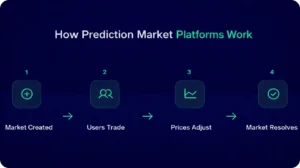
Market Creation
Each market is built around a specific question with measurable outcomes. The structure needs to remove ambiguity so that the result can be verified objectively once the event occurs.
For example, a market could be created around:
- whether a political candidate wins an election
- whether a cryptocurrency reaches a defined price by a specific date
- whether a macroeconomic event takes place within a given timeframe
- whether a sports team wins a specific match or tournament
Clarity is essential. If a market can’t be resolved with certainty, trust suffers.
Users Place Trades
Once a market goes live, participants start trading based on what they believe will happen.
If a market is at 60%, a trader who thinks the true probability is higher will buy. One who thinks it’s overstated will take the other side. The price moves accordingly.
As more users enter the market, pricing begins to reflect collective sentiment rather than individual opinion.
Prices Adjust Based on Demand
Prices update with every trade. Growing confidence in an outcome pushes prices up; doubt pulls them down. The result is a continuously updated signal of what the market collectively believes.
This aggregated view, drawn from every participant in the market, is what gives prediction markets their informational edge over any single forecast.
Market Resolution and Payouts
Once the event concludes, the market is resolved. Outcomes are verified using predefined data sources or oracles to ensure accuracy and consistency. Positions are settled, and payouts are distributed to those who correctly predicted the outcome.
At this stage, the market closes, and the trading cycle is complete, allowing new markets to be created around future events.
Prediction Markets vs Traditional Trading
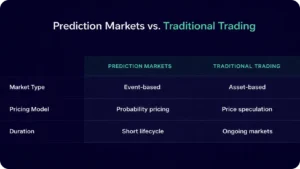
Traditional trading is shaped by market conditions, technical analysis, and macro trends, and it has no defined endpoint.
Prediction markets operate differently. Each one is built around a specific question, has a clear resolution point, and closes once the outcome is confirmed. Prices reflect probability, not value.
Key infrastructure includes a matching engine, liquidity mechanisms, data feeds or oracles, risk management systems, and settlement processes to ensure markets operate reliably and resolve accurately.
These markets serve as complementary products to exchanges and brokers. They expand trading capabilities without replacing existing products, while creating new opportunities for engagement and participation.
Why Prediction Markets Are Gaining Traction
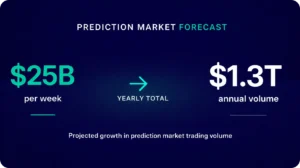
Prediction markets are gaining traction due to demand for new trading products, growing institutional interest, and their ability to surface real-time market insights.
Demand for Differentiated Trading Products
Most platforms compete on the same spot and derivative products, making it increasingly difficult to stand out. Prediction markets offer a way out of that trap; familiar enough in mechanics, but genuinely different in focus. This creates a clear opportunity for platforms competing in saturated markets to stand out.
Growing Interest from Retail and Institutional Participants
Retail users are drawn to the simplicity of outcome-based trading. Prediction markers are more intuitive, meaning these users don’t have to navigate derivatives or order books. Institutional participants are also exploring these markets as tools for aggregating information and measuring sentiment. That combination of retail accessibility and institutional utility is what’s driving broader adoption.
Real-Time Information and Market Signals
Because prices reflect collective expectations, prediction markets act as live probability indicators. In fast-moving environments, such as breaking news, macro events, and crypto volatility, that real-time signal can be more valuable than any single analyst’s forecast.
Emergence of Event-Driven Trading Models
Prediction markets are part of a broader shift in how traders engage with financial infrastructure. Users are moving beyond price speculation toward outcome-based trading tied to economic, political, and industry events. Platforms that recognize this shift early are best positioned to capture the demand.
Who Should Launch a Prediction Market Platform
Prediction market platforms are most relevant for trading businesses that are already operating or building a crypto exchange and want to expand their product offering into new categories.
This includes:
- Crypto exchanges that want to introduce new trading products beyond spot and derivatives.
- FX brokers that are exploring ways to expand into crypto and event-driven markets.
- Fintech platforms building multi-asset ecosystems
Across all three, the challenge is consistent. Traditional products are commoditizing, user acquisition costs are rising, and incremental improvements are no longer sufficient to retain active traders.
Prediction markets address several of these challenges directly.
These markets create new trading activity, deepen engagement, and give platforms a genuine point of differentiation.
They are not just another feature, but a new product category.
For growth-focused platforms, these markets are a practical and well-timed expansion that aligns product capabilities with where user demand is moving.
Key Infrastructure Behind Prediction Markets
Behind every prediction market software is a set of core systems that enable markets to operate reliably, scale efficiently, and deliver a seamless trading experience.
The concept is simple. The infrastructure required to support it is not.
Matching Engine
The matching engine is responsible for executing trades. It processes buy and sell orders in real time, enabling users to enter and exit positions efficiently. Similar to traditional trading platforms, performance and speed are critical to maintaining a smooth market experience.
Liquidity
Liquidity determines how easily users can trade without significantly impacting price. Without sufficient liquidity, markets become inefficient and less attractive to participants. Platforms typically address this through market makers or liquidity programs to ensure consistent activity across markets.
Oracle and Data Feeds
Prediction markets rely on accurate, timely data to function. Oracles and data feeds provide the information used to determine market outcomes. Whether it’s election results, economic indicators, or price thresholds, the reliability of these data sources is critical for trust and transparency.
Risk Management
Risk management systems help maintain market integrity. This includes monitoring trading activity, managing exposure, and preventing manipulation. Strong controls ensure that markets remain fair and operate within defined parameters.
Settlement Systems
Once an event is resolved, settlement systems handle payouts. They verify the outcome using predefined data sources and distribute funds to winning positions. This process must be efficient and transparent to maintain user confidence.
Risks and Considerations
Launching a prediction market platform requires a clear-eyed view of the risks involved. Regulatory exposure, liquidity constraints, and data integrity must all be addressed before going live.
Regulatory Considerations
Regulation is the biggest variable. Depending on jurisdiction, prediction markets may be treated as financial instruments, gambling products, or something else entirely. Understanding how they’re classified and building compliance from day one, such as KYC and AML, is non-negotiable.
Market Manipulation Risks
Sentiment-driven markets are inherently vulnerable to manipulation, especially when liquidity is thin. Large participants can move prices with relatively small trades, so monitoring and intervention mechanisms need to be built in from the start.
Data Reliability
Prediction market outcomes are only as reliable as the data behind them. Delayed or disputed data does not just affect settlement; it damages user trust and platform credibility. Verifiable, high-quality data feeds are a foundational requirement.
Liquidity Challenges
New markets are particularly exposed to thin liquidity. Without sufficient participation, pricing becomes unreliable, and the user experience deteriorates. Liquidity strategy must be embedded in the platform design from day one, not treated as a secondary concern.
Final Thoughts
Prediction markets are a structural shift in how trading platforms can be built. These markets are not a feature to bolt on, but a new category in their own right.
For exchanges, brokers, and fintech platforms, the opportunity is concrete. Prediction markets expand product offerings, increase user engagement, and introduce new revenue streams without requiring a fundamental rebuild of the core trading model.
Competition in traditional trading is intensifying. Platforms that move into event-driven markets early will be better positioned to differentiate, retain users, and capture demand that incumbent products are not built to serve.
To explore how to integrate prediction market infrastructure into your platform, reach out to us.
FAQs
-
What is a prediction market platform?
-
How do prediction markets work?
-
What types of events can be used in prediction markets?
-
How is pricing determined in a prediction market?
-
How do users make money in prediction markets?
-
What is the difference between prediction markets and traditional trading?
-
Who uses prediction market platforms?
-
What infrastructure is required to run a prediction market platform?
-
Are prediction markets regulated?
-
Why are prediction market platforms gaining popularity?
Share this article:
Want to learn more?
Let us save you time by walking you through what Shift can do for your business!