

Summarize with AI:
The build vs buy prediction market platform decision is one of the most critical choices an operator will make in this category. Prediction markets are drawing more attention, but attention alone doesn’t bring a product to market.
Operators need to determine how to launch in a way that supports speed, control, commercial fit, and long-term platform value. For brokers, exchanges, and fintech platforms, that choice affects launch timing, internal resourcing, native platform integration, and how quickly the business can turn interest into a live product.
Why does the build vs buy decision matter in prediction markets?
It matters because prediction markets only create value when the launch path fits the broader business model. Once the category moves from curiosity to serious evaluation, operators need to decide how to bring it live in a way that supports growth, execution, and commercial fit.
Because of how prediction markets work, these platforms aren’t a lightweight add-on. Operators need to consider market creation logic, pricing, order handling, settlement workflows, lifecycle controls, monitoring, and operational oversight. Implementing this category also has to fit into the current user experience, balances, reporting, permissions, compliance controls, and internal workflows. A weak launch path can slow the business down before the category even has a chance to prove itself.
That is where the decision becomes commercial. A built route gives the operator more ownership, whereas a buy route gives the operator a clearer path to launch. The stronger option depends on what the business needs now, not what sounds ideal in theory.
What does a custom build actually give operators?
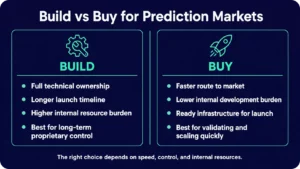
A custom build gives the operator full control over product design, internal workflows, and technical ownership. That can make sense for businesses with a large engineering team, a long planning horizon, and a strong reason to make prediction markets a major internal product pillar. When long-term ownership matters more than launch speed, custom development can be a rational choice.
There is also a strategic case for building when the operator wants every layer of the product to be proprietary. Some businesses may want deeper control over how markets are created, how internal systems interact, and how the category evolves. In that case, building can feel attractive because it keeps technical direction in-house.
Still, the value of control has to be measured against the size of the undertaking. Prediction markets require far more than a front-end market view. A custom build has to support:
- market creation and configuration
- pricing and order flow
- settlement and lifecycle controls
- monitoring and operational oversight
- integration into the wider platform environment
The primary trade-off of building a prediction market platform is that operators can maintain control, but are faced with complexity in implementing software that functions based on these factors.
What changes when an operator buys white label prediction markets infrastructure?
Choosing to buy white label prediction market infrastructure influences how operators implement this category. Instead of building core systems internally, the operator gets access to ready prediction market infrastructure that supports faster deployment and reduces the burden on internal teams. That lets the business focus more on launch strategy, market selection, positioning, and rollout.
For many operators, that is the practical advantage of white label prediction markets. The business doesn’t have to absorb the full cost and time required to create new infrastructure from scratch. It can bring prediction markets into the current trading business with greater speed and less operational friction.
Buying also clarifies the real problem the business is trying to solve. In many cases, the goal is not to own every technical layer at any cost, but to launch a commercially viable product category that fits the existing platform, supports the client experience, and can scale cleanly if demand develops. A buy route often serves that goal better than a long internal build cycle.
Why does speed to market matter so much in prediction markets?
Speed matters because prediction markets are gaining traction, and demand follows attention. A slow launch can weaken the opportunity, especially if competitors move first or the business misses the market window tied to major event cycles.
This is where buying infrastructure usually has a clearer advantage. A white label route can shorten the path from concept to launch and allow the platform to start learning from real client behavior sooner. That makes a difference because prediction markets are best refined in a market. The faster a platform launches a focused product set, the faster it can see what drives participation, which categories fit, and where expansion makes sense.
Speed also has branding value. Early movers have more room to shape how clients understand the category, how the product fits within the broader offering, and how the brand is associated with this market format. Platforms that move later may still find success, but they usually have less room to define the category on their own terms.
For operators evaluating how to launch a prediction market platform, timing determines whether the business wants to lead or follow.
How do cost and internal resources change the decision?
The build vs buy prediction market platform question also comes down to cost structure and internal focus. Building from scratch requires product, engineering, design, operations, and support capacity over a sustained period. The cost also includes testing, maintenance, upgrades, monitoring, and the internal overhead needed to keep the product operating at a high standard.
A public trading app alone costs around $40,000 to $250,000 and above, with high-end custom builds running above $300,000, and ongoing maintenance can add 15% to 25% of the initial cost annually. Not to mention, platforms also need to consider the expenses of hiring a team of engineers and developers to maintain the infrastructure.
Buying changes that model. Instead of carrying the full burden of long-term internal development, the platform can allocate more budget and focus on:
- go to market execution
- user acquisition
- product positioning
- launch support
- commercial optimization after launch
That is one reason buying often becomes the more efficient route for operators who want to validate and scale the category without absorbing unnecessary technical drag.
When is buying prediction market software the stronger route?
Buying is usually the stronger route when the business wants to move quickly, validate the category, and keep the launch operationally manageable. It’s especially relevant when internal teams are already focused on other priorities, when the business wants to add prediction markets without rebuilding the stack, or when the platform needs ready infrastructure now.
A buy route also works well when the operator values control over the client relationship but doesn’t need to own every layer of infrastructure from day one. In that case, a white label prediction market platform can still support:
- full brand alignment
- connected user flows
- integrated KYC and balance management
- operator controls and market oversight
- aggregated liquidity and faster rollout
That is what makes buying commercially attractive, as it gives the operator a practical route to market while preserving the parts of the product experience that matter most to the business.
When does building make more sense?
Building may make more sense when prediction markets are expected to become a major internal product pillar and the operator has the engineering depth, planning horizon, and financial tolerance to support it. In that case, the tradeoff of slower speed may be acceptable because the business is prioritizing ownership over early execution.
That route can also be the better option if the operator has unusually specific technical requirements that cannot be met through available infrastructure options. Even then, the business still has to answer a harder question: Is full technical ownership worth the delay, complexity, and opportunity cost that come with building everything internally?
For many operators, the honest answer will be no. That doesn’t make building the wrong choice. It means the choice has to be deliberate.
What should operators ask before choosing build or buy?
Before choosing between custom build and white label, operators should be able to answer a few practical questions:
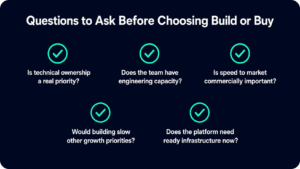
- Is full technical ownership a real business priority?
- Does the team have the engineering capacity to support a full build?
- Is speed to market commercially important?
- Would internal development slow other growth priorities?
- Does the platform need ready infrastructure now?
The same logic applies to launch readiness more broadly. A platform should also know whether it can define markets clearly, settle them cleanly, support pricing and participation, integrate prediction markets into the current user flow, and manage monitoring, support, and dispute handling without creating friction.
Evaluating these questions decides whether the category strengthens the business or turns into a slow, expensive distraction.
How does Shift Markets influence white label prediction market infrastructure?
Shift Markets gives operators a practical route into prediction markets through infrastructure designed for launch, integration, and growth. Instead of forcing operators to build a new category from the ground up, Shift helps bring prediction markets into an existing trading business with greater speed and less operational friction.
That matters because the platform needs more than event contract listings. It needs clear market creation, reliable participation, strong settlement logic, and a structure that fits the current environment. Shift’s approach is built around launch practicality, platform alignment, and real integration into the wider business.
The offering is built for operators who need more than surface access. Shift’s white label prediction markets infrastructure supports:
- full white label customization
- aggregated liquidity through sources such as Kalshi and Polymarket
- configurable market categories across crypto, finance, macro, sports, and politics
- operator Back Office controls
- native platform integration with KYC and balance management systems
Bottom line
The strongest build vs buy prediction market platform decision is the one that matches the business model. Building favors ownership and internal control, but it also brings complexity, delay, and higher ongoing demands.
In contrast, buying favors speed, efficiency, and controlled execution. For many operators, that becomes the stronger route because it turns category interest into a real product launch without stretching the business across a long internal build cycle.
If your business is weighing custom build against white label infrastructure, Shift Markets can help you assess how to go live with less friction. Reach out to our team.
FAQs
-
What does build vs buy mean for prediction markets?
-
When does buying make more sense than building?
-
When does building make more sense than buying?
-
Why is speed to market important in prediction markets?
-
What should operators look for in a white label prediction market platform?
-
Can prediction markets integrate into an existing trading platform?
-
Why is this a bottom-of-funnel decision?
Share this article:
Want to learn more?
Let us save you time by walking you through what Shift can do for your business!