

Summarize with AI:
Prediction markets are easy to understand on the surface. A user takes a position on whether an event will happen, the market price moves with demand, and the market settles when the outcome is confirmed.
What is less visible is the infrastructure required to make that experience credible. Prediction market liquidity sits at the center of these mechanics. Without strong liquidity support, prediction markets become more challenging to trust, trade, and scale.
That is why liquidity is critical in how operators implement prediction markets. It’s a critical factor determining whether the product works at all. Operators have to offer platforms that can support active pricing, reliable execution, and a stronger user experience through the right liquidity partner.
Why Prediction Market Liquidity Matters
Liquidity determines how easily clients can trade without significantly impacting price. Without sufficient liquidity, markets become inefficient and less attractive to participants.
Prediction markets depend on active pricing. The price is supposed to reflect what the market believes is most likely to happen. That only works when enough participation exists to support credible prediction market pricing. When liquidity is weak, prices become less reliable, spreads widen, and the client experience starts to break down.
This matters more in prediction markets than many operators first assume. These markets are event-driven, so activity tends to build around deadlines, headlines, and scheduled market moments. This system creates bursts of demand rather than a constant background flow. If the market cannot absorb that demand with usable pricing, the product quickly feels thin and unreliable.
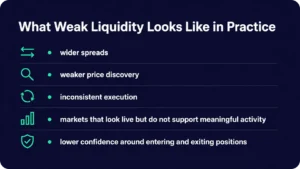
What Weak Liquidity Looks Like in Practice
Weak liquidity usually shows up in ways participants notice immediately:
- wider spreads
- weaker price discovery
- inconsistent execution
- markets that look live but do not support meaningful activity
- lower confidence around entering and exiting positions
This not only impacts users’ trading experience but also influences how prediction markets as a product perform. If clients cannot trust the pricing, they won’t trust the market. If they can’t enter or exit positions efficiently, the platform loses credibility during the moments when attention is closest. Thin liquidity is a core risk for operators who are launching new markets where unreliable pricing can damage the user experience and weaken trust.
Liquidity planning needs to be built into the launch strategy from the start. Operators must focus on the right market selection, clear visibility, and enough liquidity support to keep pricing active and participation credible. In most cases, a smaller set of active markets creates a stronger product experience than a broader catalog of markets that struggle to attract real trading activity.
Why Peer-to-Peer Liquidity Is Not Enough
Peer-to-peer participation matters in any market, but a peer-to-peer-only model is a weak foundation for prediction markets. If pricing depends too heavily on organic participation alone, markets can become patchy, especially during early launch, lower volume periods, or less active event categories.
That is the real issue operators need to understand. Operators must determine whether implementing their own prediction markets will have the pricing quality and depth needed to support real trading activity. For prediction markets for brokers and prediction markets for exchanges, that difference directly affects how credible and usable the product feels from launch.
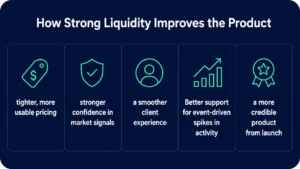
How Strong Liquidity Improves the Product
Strong liquidity improves prediction markets in several ways:
- tighter, more usable pricing
- stronger confidence in market signals
- a smoother client experience
- Better support for event-driven spikes in activity
- a more credible product from launch
This improvement in liquidity carries through the full platform experience. When prediction market liquidity is stronger, prediction markets become easier to explain, easier to trust, and easier to scale.
Higher quality markets also create stronger commercial value. When pricing is more reliable and participation is more consistent, prediction markets can support better engagement, stronger activity, and a more sustainable revenue base over time. This is where liquidity partners become important. The right infrastructure does not just put markets on screen. It helps make those markets usable.
How Shift Market Solves the Liquidity Challenge
Shift’s white-label prediction market software is built with aggregated liquidity as a core part of the offering, giving operators a stronger foundation from launch rather than leaving market quality dependent on organic participation alone.
That creates several practical advantages for operators:
- broader liquidity support from day one
- stronger pricing and market continuity
- more consistent execution across live markets
- the flexibility to apply markups and configure fees
- a more credible product experience for clients
Shift also gives operators more than access to liquidity. With configurable market categories, operator back office controls, and native platform integration, the product is designed to fit into the existing trading environment rather than sit outside it. That gives brokers, exchanges, neobanks, and fintech platforms a more practical route to market without compromising branding, operations, or the client relationship.
Bottom Line
Prediction market liquidity is one of the factors that will define the best prediction market platforms. Weak liquidity leads to weaker pricing, weaker trust, and a weaker client experience. Strong liquidity creates the opposite: better execution, better pricing, and a product that feels credible from launch.
If a business is evaluating prediction market infrastructure, liquidity should be part of the decision from the start. Shift Markets helps brokers and exchanges launch with aggregated liquidity, cleaner integration, and a faster route to market. Reach out to our team for a demo.
FAQs
-
Why does prediction market liquidity matter?
-
What happens when prediction market liquidity is weak?
-
Why are liquidity partners important for prediction markets?
-
Is peer-to-peer liquidity enough for prediction markets?
-
How does liquidity affect prediction market pricing?
-
How does Shift Markets solve the liquidity challenge?
Share this article:
Want to learn more?
Let us save you time by walking you through what Shift can do for your business!