
Summarize with AI:
A prediction market platform and a sportsbook both allow users to take positions on event outcomes, but they operate on fundamentally different models. In a sportsbook, the operator prices the odds and holds margin risk on every bet. In a prediction market, users trade contracts against each other and the operator earns a platform fee on the flow.
The structural difference of a prediction market vs sportsbook has significant implications for revenue, risk, infrastructure, and regulation. For operators evaluating which product to build or add, understanding that distinction is the starting point.
How does a sportsbook work?
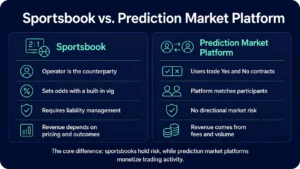
In a sportsbook, the operator acts as the counterparty to every bet. When a user bets on an outcome, the sportsbook takes the opposite side. The operator sets the odds, which include a margin known as the vig or juice, typically 5 to 12 percent. This built-in margin is how the sportsbook generates revenue across all bets placed, regardless of which outcomes win.
To manage the risk of holding positions against users, sportsbooks employ trading teams that set and adjust lines, monitor liability across markets, and manage exposure around major events. If a sportsbook takes too much action on one side of a market, it either adjusts the odds to attract the other side or lays off exposure with another operator.
The sportsbook model generates revenue from the margin on every settled bet. Its profitability depends on how accurately it prices markets, how well it manages liability, and whether outcomes break reasonably close to expectation over time.
How does a prediction market platform work?
A prediction market platform doesn’t take the other side of user positions. Instead, it provides the infrastructure for users to trade Yes and No contracts representing opposing views on an event outcome. A user who believes an outcome will happen buys the Yes contract. A user who believes it will not buys the No contract. The platform matches them and earns a fee or spread on the transaction.
Because the platform is not holding a position on the outcome, it doesn’t carry the same margin risk as a sportsbook. Its revenue comes from participation and volume, not from pricing events correctly or managing liability. A prediction market operator earns whether the Yes side wins or the No side wins.
This structural difference is the most important thing for operators to understand. The prediction market model removes directional market risk from the operator’s book. Revenue is driven by trading activity, not event outcomes.
What are the key differences between a prediction market and a sportsbook?
| Area | Sportsbook | Prediction Market Platform |
|---|---|---|
| Operator role | Counterparty to every bet | Facilitator of peer to peer trading |
| Revenue source | Margin built into odds (vig) | Spread and transaction fees on trading volume |
| Market risk | Operator holds risk on every event | Operator has no directional outcome exposure |
| Odds or pricing | Operator sets and manages | User trading activity determines prices |
| Trading desk required | Yes, to set lines and manage liability | No, market prices emerge from participant activity |
| Event coverage | Primarily sports | Sports, politics, macro, crypto, and custom events |
| Settlement | Operator controlled, centralized | Defined data sources, often automated |
| User experience | Bet and wait for outcome | Active trading, positions can be opened and closed |
| Infrastructure complexity | High, requires odds management and liability systems | Moderate, requires matching engine and settlement logic |
| Regulatory framework | Gambling regulation, state or national level | Varies, often treated as financial markets |
| Revenue margin | 3 to 12 percent hold on settled bets | 1 to 5 percent of trading volume |
| Scale dependency | Profitable at moderate volume with good pricing | Revenue scales directly with trading volume |
How do the revenue models compare in practice?
The sportsbook revenue model is margin-based. A sportsbook with a 7 percent hold on $1 million in settled bets generates $70,000 in gross gaming revenue. That hold is not guaranteed. A bad run of outcomes can compress it significantly in any given period, and major events with heavily skewed action can create short-term liability spikes that require active management.
The prediction market revenue model is volume-based. A platform taking a 3 percent spread on $1 million in daily trading volume generates $30,000 per day in gross revenue without holding any directional risk. Because the operator earns on every trade regardless of outcome, the revenue is more predictable and less sensitive to how individual events resolve.
For operators who already manage risk across FX, derivatives, or other trading products, the prediction market model is structurally familiar. The fee-on-flow model is essentially the same principle as a trading exchange charging commissions, which makes it a natural fit for operators from a trading infrastructure background.
What event categories can each product support?
A traditional sportsbook is built around sports events: match results, player statistics, in-play markets, and related propositions. Expanding beyond sports into politics, macroeconomics, or other categories requires additional data sourcing, pricing expertise, and regulatory consideration that most sportsbook platforms are not designed to handle natively.
A prediction market platform is built for broader event coverage. Sports, politics, elections, central bank decisions, crypto price events, entertainment awards, and custom proprietary markets can all run on the same infrastructure. The pricing and settlement mechanisms are the same regardless of what the event is, because the market price is determined by user trading rather than by the operator setting a line.
This multi-category capability is one of the most commercially significant differences. Prediction markets are growing precisely because the engaged audience for event-based trading extends well beyond sports. Kalshi and Polymarket combined exceeded $76 billion in trading volume in 2025, a more than 400 percent increase from 2024, driven by political and macro event markets as much as sports.
How does regulation differ between prediction markets and sportsbooks?
Regulation is one of the most operationally significant differences between the two models, and it varies significantly by jurisdiction.
Sportsbooks operate under gambling regulation. In most markets this means a gambling license issued at the state, provincial, or national level. Requirements include responsible gambling obligations, payment restrictions, marketing rules, and in many jurisdictions geographic limits on which users can be served.
Prediction markets are often regulated differently, and the framework is still developing in most major markets. In the United States, regulated prediction market operators have been classified as Futures Commission Merchants under CFTC oversight rather than gambling operators, which changes the regulatory framework and the compliance requirements substantially. Operators outside the US should assess local treatment carefully, as some jurisdictions classify prediction markets under gambling regulation and others do not.
The regulatory distinction matters commercially because it affects which users can be served, what payment methods are available, and how the product can be marketed. Operators evaluating prediction markets should get legal clarity on the applicable framework in their target markets before launch.
Can operators run both a prediction market platform and a sportsbook?
Yes, and there is a growing rationale for doing so. The two products serve overlapping but distinct user behaviors. A sportsbook user is placing a fixed bet and waiting for an outcome. A prediction market user is actively trading a position they can open and close before the event resolves. Some users prefer one model, while others engage with both.
For sportsbook operators, adding a prediction market platform gives them access to a product that attracts a more trading-oriented user while also providing multi-category event coverage that goes beyond what a sportsbook typically offers. The products can share a user base and account infrastructure without competing directly for the same behavior.
For exchange operators and brokers, prediction markets are closer to their existing infrastructure than a sportsbook is. The matching engine, account management, and settlement logic used for trading are directly applicable to prediction markets, which makes the integration path more straightforward than building sportsbook infrastructure from scratch.
Which product is the right fit?
The right product depends on the operator’s starting point, audience, and revenue model.
A sportsbook makes the most sense when the business is built around sports-first entertainment, fixed payouts, and familiar betting mechanics. This model fits operators whose users already expect traditional wagering flows and odds-based pricing.
A prediction market platform is the stronger fit when the goal is broader event trading. It allows operators to cover sports, politics, crypto, macro events, culture, and other categories through a trading-style experience rather than a fixed-odds betting model.
Brokers and exchange operators will usually find prediction markets easier to align with their existing business. The revenue model, platform infrastructure, account flows, and risk profile sit closer to what trading businesses already manage. Prediction markets can also be added as part of a multi-asset platform without requiring a traditional sportsbook operating model.
Sportsbook operators may still use prediction markets as a complementary product. This can create a path beyond fixed-odds betting into multi-category event trading without adding the same level of directional outcome exposure.
For businesses that want category flexibility, trading-style engagement, and a revenue model driven by market activity rather than house risk, a prediction market platform is usually the cleaner starting point.
Bottom Line
The fundamental difference between a prediction market platform and a sportsbook is where the risk sits. A sportsbook takes directional risk on every event it prices. A prediction market operator earns a fee on every trade without holding a position on the outcome. That difference flows through revenue predictability, infrastructure requirements, staffing, and regulatory treatment.
For operators from a trading background, prediction markets are a natural product extension. For sportsbook operators, they are a complementary product that adds a different user experience and multi-category event coverage without requiring a second trading desk.
Request a demo and our team can help you launch prediction markets.
FAQs
-
What is the difference between a prediction market and a sportsbook?
-
Do prediction market operators take market risk?
-
How do prediction market platform fees compare to sportsbook margins?
-
What events can a prediction market platform cover?
-
How are prediction markets regulated compared to sportsbooks?
-
Can a sportsbook operator add a prediction market platform?
-
Why are prediction markets growing faster than traditional sports betting?
-
Which is better for exchange operators: a prediction market platform or a sportsbook?
Share this article:
Want to learn more?
Let us save you time by walking you through what Shift can do for your business!