

Summarize with AI:
Learning how to monetize prediction markets starts with understanding how operators earn from trading activity. The core revenue model is built around spreads, transaction fees, market activity, and, at scale, data and premium access.
Unlike a sportsbook, a prediction market operator does not need to take the other side of every client trade to generate revenue. The platform can earn from the flow of trading itself, which means revenue scales with participation, volume, and market selection.
For brokers, exchanges, and fintech platforms, this makes prediction markets a practical revenue opportunity when the product is launched with the right infrastructure, liquidity model, and fee structure.
Why is the prediction market revenue model attractive for operators?
The prediction market revenue model is attractive because revenue is tied to trading activity rather than the operator’s ability to predict event outcomes.
In a traditional brokerage model, revenue is often tied to spreads, commissions, and execution quality. In a derivatives model, revenue may come from trading fees, funding rates, liquidation fees, and leveraged volume. These can be strong revenue streams, but they also require deeper risk systems and more complex exposure management.
Prediction markets work differently. The operator can earn a margin on the activity between participants. Revenue depends on whether users are interested enough to trade, not whether the operator priced the outcome correctly.
That matters for operators because it creates a direct link between audience engagement and revenue. If users care about the events, the platform has a clear path to monetization through spreads, fees, market creation, and data.
What are the main ways to monetize prediction markets?
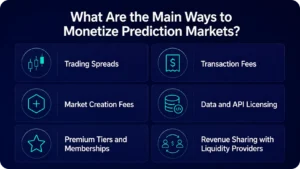
Operators can monetize prediction markets through several revenue streams. The strongest model usually combines trading spreads and transaction fees first, then adds other income streams as the platform matures.
Trading spreads
Trading spreads are one of the main ways operators monetize prediction markets. In a binary outcome market, participants trade contracts tied to each side of an event. The operator can structure pricing so the combined price of both sides includes a margin.
For example, if the Yes contract is priced at 54 cents and the No contract is priced at 48 cents, the combined total is $1.02. The difference between the total contract price and $1.00 creates a 2-cent margin on that contract pair.
A spread of 2 to 5 percent can create consistent revenue across market activity, depending on the operator’s pricing model, liquidity structure, and market design.
At $500,000 in daily trading volume, a 3 percent spread produces approximately $15,000 per day in gross operator revenue before infrastructure and liquidity costs. At $5 million in daily trading volume, the same spread produces approximately $150,000 per day.
Volume is the main lever. The spread is the mechanism that turns that activity into revenue.
Transaction fees
Transaction fees can sit alongside spread revenue.
Many operators charge a fee when users place or fill trades. Taker fees are common because they apply when a user fills an existing order. These fees often range from 0.2 to 0.5 percent of trade value, depending on the product, market type, user segment, and competitive environment.
Transaction fees create predictable income without forcing operators to widen spreads too much. That matters because pricing still needs to feel fair for active traders. If fees are too high, users may trade less often. If they are too low, the platform may not generate enough revenue at launch volume.
For platforms with frequent trading activity, transaction fees can become a meaningful part of total prediction market operator revenue.
Market creation fees
Some operators charge a fee to create or list new prediction markets.
Market creation fees can serve two purposes. They create a direct revenue stream, and they help filter out low quality or low interest markets that could clutter the platform.
For example, an operator may charge a fixed fee for a new market submission or create enterprise market packages for clients that want branded markets around specific events. This model is more relevant when the platform allows third parties, creators, communities, or business clients to launch markets.
For operators running only internal markets, market creation fees may not apply directly. But the underlying idea still matters. Market selection affects trading volume, and trading volume is what drives revenue.
Data and API licensing
Prediction market data can become valuable outside the trading platform itself.
Live market prices reflect the market’s view of future outcomes. That probability data can be useful for media companies, research firms, institutional investors, AI companies, and other organizations that want real time insight into public expectations.
Operators with meaningful volume can monetize this through data licensing, API access, historical probability data, market feeds, and premium analytics.
This revenue stream usually becomes more valuable after the platform has scale. But it is worth planning for early because the right data infrastructure makes it easier to package and monetize market information later.
Premium tiers and memberships
Some platforms add premium tiers for users who want higher limits, lower fees, early access to markets, or advanced analytics.
For brokers and exchange operators, premium tiers may connect to an existing loyalty model or client segmentation strategy. Higher volume users may receive reduced fees, stronger tools, or access to specific market categories.
This model is not usually the first revenue stream to launch, but it can support retention and increase customer lifetime value as the product matures.
Revenue sharing with liquidity providers
Liquidity structure can affect how much revenue the operator keeps.
If an operator works with external liquidity providers, there may be revenue sharing, spread sharing, or other commercial terms built into the agreement. This can reduce gross margin, but it may also improve pricing, execution, and market depth.
Operators should model this carefully. The goal is to create markets that users want to trade repeatedly. Stronger liquidity can support better volume, which may improve total revenue even if some economies are shared.
How much revenue can prediction market operators generate?
Prediction market revenue depends on three main variables: trading volume, margin, and the number of active markets.
A focused launch with a smaller but engaged user base can still produce meaningful revenue if users trade frequently. For example, a platform generating $100,000 in daily trading volume with a 3 percent spread would produce approximately $3,000 per day in gross revenue, or around $90,000 per month.
At $1 million in daily trading volume with a 2.5 percent spread, the same model produces approximately $25,000 per day, or around $750,000 per month.
These are gross revenue examples before platform, liquidity, operational, and compliance costs. Net revenue depends on the operator’s infrastructure model, liquidity agreements, fee structure, and internal operating costs.
The larger market opportunity is also growing. Research from early 2026 projected that prediction market firms could reach $10 billion in annual industry revenue by 2030. For operators with an existing client base, early positioning can matter. The sooner the product is live, the sooner the platform can build trading behavior, market coverage, and revenue history.
How does the prediction market revenue model compare to other trading products?
| Revenue Dimension | Prediction Markets | Spot Crypto Exchange | Crypto Derivatives |
|---|---|---|---|
| Primary revenue source | Spreads and trading fees | Trading fees and spreads | Trading fees, funding rates, liquidation fees |
| Market risk to operator | Lower when matching participants | Lower if not taking principal risk | Higher depending on the model |
| Revenue from day one | Possible when markets are active | Possible when users trade | Possible, but requires deeper liquidity and risk systems |
| Revenue scales with | Trading volume, market selection, and participation | Trading volume and asset coverage | Leveraged volume, open interest, and active position management |
| Data monetization potential | High because prices reflect crowd expectations | Moderate | Moderate |
| Regulatory complexity | Varies by jurisdiction and product type | Moderate depending on jurisdiction | Higher in most markets |
| Infrastructure cost to launch | Moderate with the right provider | Moderate | Higher due to margin, liquidation, funding, and risk systems |
What infrastructure decisions affect prediction market revenue?
How an operator structures the platform has a direct impact on revenue potential. The product needs to be easy to access, liquid enough to trade, and built around markets that users care about.
Liquidity model
Liquidity affects pricing, execution, and user confidence.
An operator running custom markets with direct market making may have more control over spreads and revenue. On the other hand, an operator routing flow to external liquidity may share some margin but benefit from better market depth and tighter pricing.
The right model depends on the operator’s audience, risk appetite, launch scale, and market categories.
Market selection
Revenue follows attention.
Operators generate more trading activity when they launch markets around events their audience already cares about. A broker with crypto traders may see stronger early traction from crypto, macro, or market related events. A sports focused audience may respond better to match outcomes, tournament results, or seasonal markets.
The more relevant the market is to the existing audience, the faster volume can build.
Fee structure
Operators need a fee structure that supports revenue without discouraging activity.
Spreads and transaction fees should be high enough to generate meaningful revenue at launch volumes, but not so high that they reduce trading behavior. This requires modeling expected volume, user activity, liquidity costs, and competitive pricing before launch.
As volume grows, operators can refine fees, introduce user tiers, or create market specific pricing.
Integration depth
Native integration can improve revenue because it reduces friction.
Prediction markets connected to an existing exchange, brokerage, or trading platform can reach users who are already onboarded, funded, and active. That is very different from launching a separate product that requires new sign ups, new funding flows, and new user behavior from scratch.
For operators, integration depth can shorten the path from product launch to trading volume.
How should operators choose the right monetization strategy?
Operators should not treat prediction market monetization as a single fee decision. The right strategy depends on audience, market type, liquidity model, product maturity, and launch goals.
At launch, most operators should focus on a simple structure: clear spreads, transparent trading fees, strong market selection, and enough liquidity to create a good user experience. Once volume grows, they can add more advanced revenue streams such as premium tiers, market creation fees, data products, or enterprise API access.
Key questions to answer before launch include:
- Does the audience already care about the event categories?
- Will the platform use internal markets, external liquidity, or a mixed model?
- How much spread can the market support without reducing trading activity?
- Should transaction fees apply to all users or only certain order types?
- Will market data be structured in a way that can be licensed later?
- Can prediction markets connect to the existing account and funding flow?
- What reporting will finance, risk, and operations teams need?
The strongest prediction market business model is usually the one that starts simple, supports volume, and leaves room to add more income streams over time.
How does Shift Markets help operators monetize prediction markets?
Shift Markets provides prediction market infrastructure that connects to an operator’s existing platform environment. That matters because revenue depends on access, activity, liquidity, and operational control.
When prediction markets are available to clients who are already funded and active, operators can start building trading volume sooner. The product becomes part of the existing trading environment rather than a separate experience that users need to discover, fund, and learn from scratch.
Shift Markets supports configurable spread and fee structures, multiple market categories, liquidity workflows, settlement workflows, and back office visibility. Operators can structure their prediction market revenue model around spreads, transaction fees, or a combination of both, with room to adjust as volume grows.
Bottom Line
Operators earn through spreads, transaction fees, and, over time, additional income streams such as market creation fees, data licensing, API access, and premium tiers.
For brokers and exchange operators, the opportunity is strongest when prediction markets are launched inside an existing trading business where clients are already onboarded, funded, and active. That gives the operator a clearer path to volume, better user adoption, and faster revenue development.
Request a demo to learn how Shift Markets can support your prediction market launch.
FAQs
-
How do you monetize prediction markets?
-
How do prediction market operators make money?
-
What is a prediction market spread?
-
Do prediction market operators need to take market risk?
-
How much revenue can a prediction market operator generate?
-
How does native integration affect prediction market revenue?
-
What revenue streams exist beyond trading fees?
Share this article:
Want to learn more?
Let us save you time by walking you through what Shift can do for your business!