
Summarize with AI:
Native prediction market integration lets brokers add event-based trading inside their existing platform instead of sending clients to a separate product. This approach keeps control over the client relationship, account structure, funding flows, liquidity, settlement, reporting, risk controls, and back-office workflows while adding a genuinely new trading category.
This allows brokers to launch in one of the fastest-growing trading categories while working inside the same platform environment that clients and internal teams already use.
Why should brokers avoid sending clients to a separate prediction market platform?
Sending clients to a third-party prediction market platform may solve the access problem, but it creates new ones. Even when the broker technically offers the category, a disconnected experience can weaken brand ownership, split client activity, reduce reporting visibility, and create more operational work.
Client ownership
When clients leave the broker environment to trade elsewhere, the relationship starts shifting toward that third-party platform. Over time, that makes it harder for the broker to own the experience, monetize future activity, and build the kind of long-term product loyalty that actually matters for retention.
Operational visibility
A separate platform fragments the broker’s view of the business. Monitoring trading activity, balances, client behavior, disputes, and market performance through existing workflows becomes harder or simply impossible when activity is split across systems.
Product adoption
Prediction markets are more likely to gain traction when clients can access them inside the account environment they already use. Extra steps, separate logins, and disconnected funding flows add friction at every stage, and friction is where adoption stalls.
What does native prediction market integration mean?
Native prediction market integration means adding prediction markets inside the broker’s existing platform experience, rather than redirecting clients to an external product.
It should connect to:
- Existing client accounts
- KYC and onboarding flows
- Funding and withdrawals
- Trading access
- Liquidity pathways
- Settlement workflows
- Risk controls
- Reporting
- Back-office permissions
- Support and compliance workflows
The product should feel new to the client, but it should not require the broker to build and manage a completely separate operating model.
What infrastructure is needed for native prediction market integration?
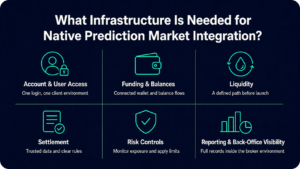
A broker needs more than a front-end market screen. Prediction markets require infrastructure that can support real trading activity, operational review, and client trust across the full stack.
Account and user access
Clients should access prediction markets through the same account environment they use for everything else. Requiring a separate login or isolated wallet creates unnecessary friction and undermines the native experience from the start.
Funding and balances
The product needs to connect cleanly to the broker’s existing funding, wallet, or account balance model. Isolated funding flows create reconciliation work and make the product harder for clients to use day-to-day.
Liquidity
The broker needs a clear, defined liquidity path, whether through external liquidity, offsetting flow, direct market making, or custom markets. Liquidity planning should happen before launch, not after.
Settlement
Each market needs a defined outcome, a trusted data source, and clear settlement rules established before it goes live. Ambiguity here creates client disputes and operational risk.
Risk controls
The broker needs tools to monitor exposure, apply limits, pause markets, and review unusual activity especially around high-volume events where prediction markets can spike quickly.
Reporting and back-office visibility
Operations, compliance, and support teams need direct access to activity records, balances, settlement outcomes, user actions, and market performance inside the broker’s existing environment, not a third-party dashboard.
How can brokers add prediction markets without rebuilding their platform?
Brokers don’t need to rebuild their entire technology stack to launch prediction markets. A provider, like Shift Markets, can supply the infrastructure layer that connects prediction markets to the broker’s existing platform environment.
A practical launch path looks like this:
- Identify the client segment and market demand
- Choose the prediction market categories to launch first
- Define liquidity and settlement requirements
- Map the product into existing accounts and funding flows
- Connect reporting, risk, and back-office controls
- Launch with a focused market set
- Expand based on activity and client demand
What should brokers look for in a native prediction market integration provider?
Brokers should look for a provider that supports both launch speed and operational control, not one at the expense of the other.
The right provider should be able to run the product under the broker’s brand, fit into the existing client journey without requiring separate environments, and support clear liquidity and settlement workflows from day one. Risk teams need to be able to monitor exposure. The back office needs visibility. Compliance needs access to reporting. And the product needs to scale as volume grows.
Beyond the technical checklist, the provider should understand brokerage operations. Prediction market infrastructure built for retail consumers is a different concept from infrastructure built for regulated brokers managing real client accounts.
Separate platform vs. native prediction market integration: what is the difference?
| Area | Separate Prediction Market Platform | Native Prediction Market Integration |
|---|---|---|
| Client experience | Clients leave the broker environment | Clients access markets inside the broker experience |
| Brand ownership | Relationship may shift to another platform | Broker keeps the brand and client relationship |
| Funding | Separate funding flow may be required | Funding can connect to existing account flows |
| Reporting | Activity may sit outside broker systems | Activity can connect to back-office reporting |
| Risk visibility | Broker may have limited control | Broker can monitor exposure and limits |
| Support | Issues may require third-party coordination | Support teams have clearer operational context |
| Compliance | Review may be fragmented | Reporting and controls can fit broker workflows |
| Growth | Harder to build a unified product experience | Easier to expand into multi-asset trading |
A separate platform may give a broker access to prediction markets. A native integration gives the broker a prediction market business.
What are the risks of using a disconnected prediction market setup?
A disconnected setup may give the broker access to prediction markets, but it tends to create compounding problems across client ownership, operations, reporting, risk, and long-term product growth.
Lower client retention
When clients build trading habits on a third-party platform, that platform earns the loyalty, not the broker. The more active a client becomes on the external product, the harder it is to bring them back to the broker’s own environment.
Fragmented reporting
Trading activity, balances, and client behavior sit outside the broker’s main reporting environment. That means teams are working from an incomplete picture, which creates problems for compliance, risk, and any decision that depends on full visibility.
More operational work
Managing separate systems, workflows, and support processes takes time and creates headcount pressure. What starts as one extra tool can quickly become a real operational drag as volume grows.
Weaker product control
When the product lives on another platform, the broker’s influence over the user experience, market design, and monetization model is limited, and that limitation becomes more costly as the category matures.
How does Shift Markets help brokers add prediction markets natively?
Shift Markets helps brokers add prediction markets through infrastructure built for platform integration, liquidity, settlement, reporting, risk controls, and operational visibility.
Shift supports brokers with:
- Branded prediction market launch
- Native platform integration
- Liquidity and settlement workflows
- Risk management controls
- Back-office visibility
- Reporting and compliance support
- Operational launch planning
The goal is to help brokers add event-based trading without moving clients into a disconnected product or building the full stack from scratch.
Bottom Line
Prediction markets can become a strong product category for brokers, but only if the experience fits inside the broker’s platform. Sending clients to a separate product may solve the access problem, but it weakens ownership, visibility, and long-term control.
Shift Markets helps brokers bring prediction markets into their existing platform strategy so they can launch event-based trading without moving clients elsewhere. Reach out to our team to discuss the right integration path for your platform.
FAQs
-
What is native prediction market integration?
-
Why should brokers avoid separate prediction market platforms?
-
Can brokers launch prediction markets under their own brand?
-
What infrastructure is required for prediction market integration?
-
How does native prediction market integration support risk management?
-
Should brokers build or buy prediction market infrastructure?
Share this article:
Want to learn more?
Let us save you time by walking you through what Shift can do for your business!