
Summarize with AI:
Traditional products are no longer enough for trading platforms to increase their revenue. Prediction markets provide a clear solution, allowing these platforms to expand their offerings and target a new audience.
As prediction market platforms gain traction, discussion is focusing on how they strategically fit into trading platforms. This is where specific use cases become more relevant. For exchanges, brokers, and fintechs, the key question is how they can implement prediction markets to support product strategy, platform engagement, and broader market participation.
Operators shouldn’t replace spot or derivatives with prediction markets; instead, they should establish these markets as an adjacent category within a broader trading environment. Fortunately, prediction markets offer a wide range of use cases for operators adopting this trading activity.
Why Trading Platforms Are Expanding into Prediction Markets
Prediction markets are attracting more attention because of how these platforms work. This category introduces a different type of market participation without compromising the logic of traditional trading.
These markets give operators a way to offer:
- participation tied to whether a specific event will happen
- event-based trading alongside more familiar products
- a market format that feels distinct without feeling disconnected from the platform
That distinction matters because it changes how the product is understood and how it fits within a broader trading environment.
The strongest use cases of prediction market platforms align with how people already follow markets, news, and major events. These use cases are tied to events that already garner attention, produce clear outcomes, and have a natural fit with the platform’s existing audience.
Prediction Market Use Cases in Trading Platforms
The most noticeable prediction market use cases include event-driven trading, crypto native event markets, new engagement formats, topical market categories, and a product in addition to spot and derivative trading.
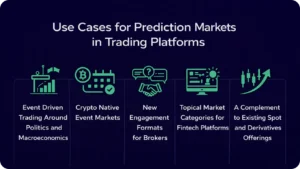
Event Driven Trading Around Politics and Macroeconomics
Geopolitics, macroeconomics, and politics now account for the majority of activity across prediction markets. Elections, inflation releases, interest rate decisions, GDP prints, and other scheduled economic events already attract attention across financial markets. Prediction markets turn that attention into a direct market format.
This is one of the most practical use cases for operators because these events are time-bound, widely followed, and usually easy to resolve against a defined source. This combination matters for event-based trading platforms as operators can adopt a market category that is easy to explain and naturally tied to moments that participants are already interested in.
For example, a platform could launch markets around whether the Federal Reserve will cut rates at its next meeting, whether CPI will come in above a certain threshold, or which party will win a major election. Each of those events already has an audience, a timetable, and a clear resolution point, which makes them easier to structure and easier for participants to understand.
Crypto Native Event Markets
While politics and macroeconomics account for most of prediction market trading activity, crypto markets are close behind. Platforms can structure markets around token milestones, ETF approvals, protocol upgrades, major listings, regulatory decisions, or price threshold events tied to a specific date.
A clear example is a crypto exchange wanting to launch a market on whether a spot ETF will be approved by a certain deadline, whether a major protocol upgrade will go live on schedule, or whether Bitcoin will close above a defined price before the month’s end. These are the kinds of events crypto participants already track closely, which makes the market easier to understand and easier to connect to existing interests.
Rather than creating a broad directional trade, the market centers on a defined event. This makes it easier to turn crypto news and expectations into a tradable format without simply repeating the spot or derivatives experience participants already have access to.
New Engagement Formats for Brokers
Another use case for prediction markets for brokers is creating a different engagement model from traditional price-based exposure. Brokers already operate in environments shaped by macro events, central bank decisions, and scheduled data releases. Prediction markets give them a way to frame those moments around outcomes rather than only price reaction.
For example, a broker could offer markets around whether the European Central Bank will cut rates at its next meeting, whether US inflation will come in above forecast, or whether a major election result will be confirmed by a certain date.
These use cases are strategic for firms looking to broaden participation without relying only on familiar product flows. The value is not in replicating existing products under a different label but in creating a simpler format tied to defined outcomes, particularly around events that already shape trading behavior in FX and broader financial markets.
Topical Market Categories for Fintech Platforms
Prediction markets can open a different way for fintech platforms to think about participation around information, timing, and financial relevance. These platforms may not always approach the category in the same way as an exchange or broker, but they can still use prediction markets to build around policy events, economic releases, sector developments, and other real-world outcomes.
An example of this is a fintech platform offering markets around whether inflation will fall below a certain level by quarter end, whether a major policy bill will pass, or whether a specific sector will see a key regulatory approval within a defined timeframe.
This is one of the more flexible use cases because it allows fintech platforms to build around topics that feel timely and understandable without requiring deep asset exposure. The category can support a broader market experience while still staying close to financial behavior and decision-making.
A Complement to Existing Spot and Derivatives Offerings
One of the most critical use cases of prediction market platforms is as a complement to existing products. These markets don’t need to replace spot or derivatives to be valuable. Operators can leverage the most value from this category by positioning it alongside those products and expanding the range of ways participants engage with a platform.
This is especially relevant in the context of prediction markets versus traditional trading. The goal is not to collapse the two into one another. It’s important to recognize that each type of trading serves different purposes.
Traditional trading is built around asset prices, whereas prediction markets are built around outcomes. This difference gives platforms another market category that can feel distinct while still fitting within the same broader environment.
Which Use Cases Make the Most Sense for Different Platform Types
Different operators will not use prediction markets in the same way. The strongest fit depends on the audience, the broader product mix, and the role prediction markets are meant to play on the platform.
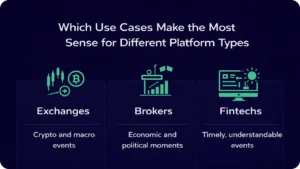
Exchanges
Prediction markets are most strategic for crypto exchanges expanding their product mix without drifting too far from what their audience already follows. Crypto native events, macroeconomic releases, and widely watched public outcomes are all strong candidates because these events can generate participation around moments that already carry market attention.
For exchanges, use cases are strongest when they add a new format that feels distinct from spot and derivatives while still fitting the expectations of active market participants.
Brokers
For brokers, prediction markets are strongest when these platforms create a simpler event-based format around moments that already influence market behavior. Central bank meetings, economic releases, and political outcomes are all natural examples because they already shape how broker audiences think about risk, timing, and opportunity.
The category can broaden participation beyond standard price-driven activity and create a different type of market engagement without stepping outside a trading context.
Fintechs
Prediction markets make the most sense for fintechs who want to connect financial participation to timely, understandable events. Economic data, policy changes, company milestones, and broader market developments can all support this type of approach.
This trading category is useful for fintech platforms because it offers a flexible market model that can feel more direct than traditional trading while still preserving the logic of participation, pricing, and resolution.
What Makes a Strong Prediction Market Use Case
Whether it’s prediction markets for fintechs, brokers, or exchanges, the value of prediction markets depends on the quality of the use case. Not every event belongs on a platform simply because it can be turned into a question.
The strongest use cases are the ones that fit naturally within a trading environment and make sense for the audience the platform is trying to serve.
Strong prediction market use cases usually have:
- a clear event
- a defined outcome
- a reliable source for resolution
- a natural fit with the platform’s audience
- enough attention to support participation
These are the factors that separate a useful market from a weak one. Prediction markets work best when the event already matters, the structure is easy to understand, and the market has a clear role within the broader platform experience.
That matters for any firm evaluating prediction market software or white-label prediction markets. Infrastructure still matters, but the use case has to make sense first. The best prediction market platform is not the one that can launch the most markets. It is the one that can support the right markets for the right audience.
Why Prediction Markets Matter for Broader Product Strategy
Prediction market use cases matter because they help operators move from category interest to product fit. At this stage, operators need to determine how prediction market platforms support the broader product strategy.
For operators evaluating product direction, prediction markets can play a role in:
- expanding the product mix beyond standard categories
- creating a different type of engagement around live events
- introducing a market format that is easier to explain and position
- opening adjacent participation without abandoning the logic of trading
- testing a new category that can sit alongside existing offerings
That is what makes them relevant at the middle of the funnel. The focus shifts from market visibility to platform relevance.
For some firms, prediction markets may support product expansion. For others, they may serve as a way to create more event-driven participation or introduce a category that feels distinct from spot and derivatives. In both cases, the real value comes from understanding what role the category serves and whether that role fits the platform’s audience, business model, and broader product priorities.
Prediction markets are rapidly growing and becoming relevant in product strategy conversations because they offer a separate market model that still fits within a trading business. For the right platform, that makes them worth evaluating seriously.
Final Thoughts
Prediction market use cases are becoming more relevant because the category has moved beyond basic curiosity. For exchanges, brokers, and fintechs, the opportunity is no longer only about understanding prediction markets in theory. It’s about identifying where these platforms fit and how they can support a broader product strategy.
The strongest use cases are tied to real attention, clear outcomes, and a natural fit with the platform’s audience. Those qualities are what make prediction markets useful as part of a broader trading environment rather than a standalone idea.
If you are evaluating how prediction markets could fit into your platform strategy, reach out to Shift Markets to continue the conversation.
FAQs
-
What are the main prediction market use cases for trading platforms?
-
Why are prediction markets useful for exchanges?
-
How can brokers use prediction markets?
-
What makes a strong prediction market use case?
-
Are prediction markets a replacement for traditional trading?
Share this article:
Want to learn more?
Let us save you time by walking you through what Shift can do for your business!