
Summarize with AI:
Prediction market risk management covers the operational, settlement, liquidity, manipulation, and regulatory risks a platform carries when running event contracts. Unlike derivatives or sportsbook models, a prediction market does not give the platform directional exposure. Both sides of every binary contract net to zero at settlement. But that does not make the platform risk-free.
Oracle failure, settlement disputes, thin order books, manipulated markets, and regulatory classification all create meaningful exposure for businesses running prediction market infrastructure. Understanding each risk category and the controls available is foundational before going live.
What types of risk does a prediction market platform face?
Prediction market risk falls into five categories. Each one is distinct from traditional financial risk and requires its own set of controls.
Oracle and data source risk: settlement depends on an external source confirming the correct outcome. If that source returns incorrect, premature, or unavailable data, the platform resolves the contract incorrectly, creating financial liability and reputational damage.
Settlement dispute risk: even a technically correct settlement can generate disputes when outcome definitions are ambiguous, or events resolve in unexpected ways. Each dispute requires admin review, potential reversals, and user communication.
Liquidity risk: binary event markets depend on bilateral matching. One sided books produce poor trading experiences and amplify the impact of manipulation attempts on thin markets.
Market manipulation risk: coordinated trading, wash trading, and spoofing are more damaging in low liquidity markets where moving prices is cheap, and activity patterns are harder to distinguish from normal volume.
Regulatory risk: CFTC classification of event contracts, state level gaming law overlap, and event category restrictions create a complex and evolving compliance landscape, particularly for platforms serving US users.
How does prediction market risk compare to derivatives and sportsbook risk?
Platforms coming from FX, derivatives, or sportsbook backgrounds often assume prediction market risk works the same way. The risk profile is structurally different in ways that affect how you staff, capitalize, and configure your platform before launch.
| Risk Factor | Prediction Market | Derivatives Exchange | Sportsbook |
|---|---|---|---|
| Directional exposure | None; contracts balance to zero | High without adequate hedging | High; unbalanced books held by house |
| Oracle / data dependency | Critical for every settlement | Low; market price is the reference | Medium; official result feeds |
| Settlement dispute risk | High; outcome definitions matter significantly | Low; price is objective | Low; official results are authoritative |
| Manipulation risk | Medium to high on thin markets | Medium; surveilled markets | Low; house sets the line |
| Liquidity risk | Medium to high; bilateral matching required | Managed via market makers | Managed via line adjustments |
| Regulatory risk | High; CFTC, state law, event categories | Medium; established framework | High; gaming license requirements |
| Capital requirements | Low; no directional inventory | High; margin and insurance pools | High; exposure reserves |
| Counterparty risk | Low; escrow holds matched funds | High; margin calls and liquidations | None; house model |
The core structural advantage of the prediction market model is the absence of directional exposure. Every contract is bilaterally matched; funds from both sides sit in escrow until settlement. The platform does not win or lose based on which outcome occurs. That is fundamentally different from a sportsbook that absorbs unhedged book exposure, or a derivatives exchange that runs a guarantee fund for margin shortfalls.
The trade is that oracle and settlement risk, essentially nonexistent in derivatives, becomes the central operational risk for prediction market platforms. Teams that understand this distinction before launch are the ones that build the right controls from the beginning rather than retrofitting them after the first settlement failure.
What is oracle risk and how do platforms manage it?
Oracle risk is the possibility that the data source used to confirm a settlement outcome returns an incorrect, premature, or unavailable result. Because settlement is automatic and binary, a bad oracle input triggers the wrong payout for every position in the contract. There is no partial error; the entire contract resolves on what the data source returns.
Oracle failures take three common forms:
- A feed updates before the event officially concludes, triggering settlement on an incomplete result
- A data source returns incorrect data due to a feed error, API issue, or source update that does not reflect the final official outcome
- A source becomes unavailable at the moment resolution triggers, leaving the settlement engine without a confirmed input
Platforms manage oracle risk by specifying the data source at contract creation and locking it before the market opens. This removes ambiguity about what governs settlement and gives users full visibility before they enter a position. A settlement review window between outcome confirmation and payout finalization gives your team time to catch incorrect resolution before funds transfer. Maintaining fallback sources for high volume event categories reduces exposure when a primary feed fails.
For prediction markets built on white label infrastructure, oracle configuration is a platform level decision. The team specifies the source; the infrastructure queries it and passes the result to the settlement engine. The review window and escalation path are for the business to define.
How does liquidity risk work in binary event markets?
Liquidity risk in a prediction market is structurally different from liquidity risk in spot or derivatives trading. There is no continuous price discovery. Each contract is binary, and the order book fills from participants taking opposite views on a single outcome. Both sides need participation for the market to function.
One sided books create three compounding problems. First, new participants cannot enter at a reasonable price when the book is thin on one side. Second, a heavily lopsided book leaves a large pool of unmatched funds waiting for counterparties that may not arrive, which reduces the perceived activity and credibility of the market. Third, thin markets lower the cost of price manipulation: a relatively small order can move contract prices significantly when depth on the other side is limited.
Platforms manage liquidity risk through position limits that prevent any single participant from dominating a market, market suspension controls that let teams pause trading when books become dangerously imbalanced, and event selection that concentrates early activity on higher interest categories where bilateral participation is more likely.
Exchanges and brokers adding prediction markets to a platform with an established user base start with a natural liquidity advantage. The existing client base provides a starting pool of bilateral participants that standalone platforms building from scratch lack on day one.
How do platforms detect and prevent market manipulation?
Manipulation in prediction markets takes three primary forms: coordinated trading between controlled accounts to move contract prices, wash trading between related accounts to inflate volume metrics, and spoofing, placing and quickly canceling large orders to mislead other participants about market depth and direction.
Thin markets are more susceptible because the cost of moving prices is lower and the signal of suspicious behavior is harder to separate from normal low volume trading.
Controls that reduce manipulation risk include:
- Per user position limits that cap how much of a single contract any one participant can hold
- Account level monitoring for coordinated order patterns across related accounts
- Volume thresholds that flag markets where a high proportion of activity traces to a small number of accounts
- Real time trading halt authority that lets admins suspend a specific contract when anomalous activity is detected
- Full order lifecycle audit logging that supports post event review and regulatory reporting
The implementation in prediction markets is similar to derivatives. What triggers review differs because the informational edge in prediction markets comes from knowledge about outcomes rather than directional momentum.
What settlement risk do prediction market platforms carry?
Settlement risk is the exposure that arises when the resolution process produces the wrong outcome, and payouts have already been processed. Once funds have transferred, reversing a settlement requires direct intervention, creates user trust issues, and may generate legal exposure depending on the contract volume involved.
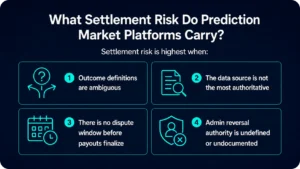
Settlement risk is highest when:
- Contracts are written with ambiguous outcome definitions that allow multiple interpretations of the same event
- The designated data source is not the most authoritative source available for that event type
- The platform does not build in a dispute window before payouts finalize
- Admin authority to reverse a settled contract is undefined or undocumented
Reducing settlement risk starts at contract creation. Precise, unambiguous outcome language, a named authoritative data source, and documented resolution criteria all reduce the likelihood of a dispute arising after the fact. A predefined dispute window with clear admin escalation authority handles the cases that reach the platform despite well designed contracts.
What regulatory risk do prediction market platforms face?
Regulatory risk is one of the most significant areas of ongoing uncertainty for prediction market platforms, particularly in the United States. The CFTC has authority over event contracts that fall under the definition of futures or swaps, and the agency has historically taken an expansive view of its jurisdiction.
The key regulatory risk areas are:
- CFTC designation: event contracts may be classified as futures, requiring the platform to operate as a Designated Contract Market or Swap Execution Facility; operating without the correct designation creates serious legal exposure
- State gaming law overlap: prediction markets on sports and political outcomes may trigger state gaming regulations in addition to federal oversight, particularly for platforms serving US retail users
- Event category restrictions: certain event types including assassination, war, and natural disasters have been specifically targeted for restriction; offering these categories creates direct regulatory exposure
- Jurisdictional complexity: platforms serving users across multiple jurisdictions must map their event categories and user base against a fragmented and evolving regulatory landscape
What do exchanges control versus what the infrastructure handles?
Building on white label prediction market infrastructure separates the controls the team owns from the mechanics the platform executes automatically.
Operators configure:
- Contract specifications: event definition, outcome states, settlement data source, review window, and expiry
- Position and exposure limits: per user caps on contract holdings across individual markets and across the full book
- Market controls: the ability to pause, suspend, or halt specific contracts in response to anomalous activity or data source issues
- Dispute and escalation policy: who has authority to reverse a settlement, what evidence standard applies, and what communication goes to affected users
- Event approval workflow: internal review before a contract goes live ensures outcome definitions are precise and the data source is confirmed before trading opens
The infrastructure handles:
- Escrow mechanics that hold funds from both sides of every contract until settlement
- Oracle queries that retrieve outcome data from the configured source
- Resolution triggering and payout processing once the settlement window closes
- Full audit logging of every order, trade, and settlement event
- Back Office reporting and position visibility across the full book
Bottom Line
Prediction market risk is real, but it is different from what most exchange and brokerage teams expect. The platform carries no directional exposure, but oracle failures, settlement disputes, manipulation on thin books, and regulatory classification all require active management. Getting the controls right before the first contract goes live is significantly easier than building them after a settlement failure.
Shift Markets provides prediction market infrastructure for exchanges and brokers, including oracle configuration, settlement workflows, position controls, and full Back Office visibility. Reach out to our team to request a demo.
FAQs
-
What is prediction market risk management?
-
Do prediction market platforms take on directional risk?
-
What is oracle risk in a prediction market?
-
How do prediction market platforms prevent manipulation?
-
What happens if a prediction market settles incorrectly?
-
How is prediction market risk different from sportsbook risk?
-
What regulatory risks do prediction market platforms face?
Share this article:
Want to learn more?
Let us save you time by walking you through what Shift can do for your business!