

Summarize with AI:
Prediction market settlement is the process of resolving an event contract once its outcome is known. Winning shares pay a fixed value, typically $1.00 per share or the equivalent in your platform’s base currency. Losing shares expire at zero.
Resolution triggers when a verified data source confirms the outcome, either automatically through an oracle integration or through an admin review. For businesses launching a prediction market, settlement infrastructure is one of the most critical design decisions before going live: it determines contract integrity, user trust, and the operational load your team carries as volume grows.
What is prediction market settlement?
Settlement is the final step in a prediction market contract lifecycle. When a user buys a share in an event contract, for example, “Will the Fed raise rates in September?”, they hold a position worth either its full payout value or zero depending on what happens. Settlement is the process of confirming which outcome occurred and distributing funds accordingly.
A well designed settlement system answers three questions:
- What outcome occurred?
- Who or what decides?
- When does the payout process?
The answers define the settlement infrastructure your platform needs to support before launch.
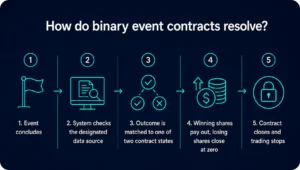
How do binary event contracts resolve?
In binary prediction market platforms, each contract has exactly two possible outcomes. Shares on the winning side pay out at the full settlement value and shares on the losing side close at zero. The platform sets the payout per winning share at contract creation, so users know exactly what a correct prediction returns before they enter a position.
Resolution follows this sequence:
- The event concludes, for example, the election certifies, the game ends, or the central bank announces its decision
- The settlement system queries the designated data source for the outcome
- The system matches the returned outcome to one of the contract’s two states
- Winning positions receive their payout and losing positions close at zero
- The contract closes and no further trading is accepted
This fixed, binary structure is what makes prediction markets auditable and resistant to settlement disputes when the underlying outcome definition is precise.
What data sources determine settlement outcomes?
Settlement reliability depends entirely on the data source used to confirm the outcome. A reliable source needs to be publicly verifiable, updated promptly when the event concludes, and authoritative enough that the result is difficult to dispute.
Common data sources for prediction market settlement include:
- Official government or regulatory bodies for political events, including election certification results and regulatory decisions
- Sports data providers and official league results feeds for sports markets
- Financial exchange closing prices or index levels for economic and macro events
- News wire services and official organizational announcements for geopolitical events
- On chain data for crypto events such as token prices at a specific block or timestamp
The data source is specified at contract creation and visible to users. Platforms that rely on ambiguous or subjective sources face higher dispute rates and reputational risk when settlement results are contested.
What is a prediction market oracle?
An oracle is the mechanism that retrieves real world data and delivers it to the settlement system. It bridges the confirmed outcome and the platform’s internal contract resolution logic.
For most B2B prediction market infrastructure, a centralized oracle is the standard approach. The platform specifies the data source and resolution logic when the contract is created. When the event concludes, the oracle queries the source and passes the result to the settlement engine, which triggers payouts automatically. Your team defines the oracle setup; the resolution itself requires no further manual input.
Decentralized oracles, used in on chain platforms like Polymarket, rely on a distributed network of data providers that attest to the correct outcome, with disputes resolved through a governance mechanism. This model is more transparent but adds complexity and latency that most operated B2B platforms do not need.
For prediction markets built on white label exchange infrastructure, the oracle is a configurable feed integration your team points at a trusted source when creating the contract. The infrastructure handles the query and resolution trigger automatically.
What does automated settlement look like?
Automated settlement completes the full resolution cycle without manual intervention once the event concludes. The flow is:
- The settlement engine monitors the event status
- When the event closes, the oracle queries the configured data source
- The source returns the outcome
- The settlement engine matches the outcome to the contract state and triggers payouts
- Users see winnings credited and the contract marked as resolved
Automated settlement scales well. A platform running hundreds of simultaneous contracts cannot rely on admin review for each resolution. It also removes the perception of bias in politically sensitive or high stakes events.
The tradeoff is that automated settlement is only as reliable as its data source. Feed errors, delayed updates, or ambiguous outcome definitions can trigger incorrect resolution. Well designed platforms include a review window and dispute mechanism to catch these cases before payouts finalize.
Automated vs manual settlement: what is the difference?
| Factor | Automated Settlement | Manual Settlement |
|---|---|---|
| Resolution trigger | Oracle queries data source automatically | Admin reviews and approves outcome |
| Speed | Immediate on data confirmation | Delayed by review process |
| Human involvement | None after initial setup | Required for each resolution |
| Dispute handling | Contested outcomes escalate to manual review | Admin has direct override authority |
| Best for | High volume, objective, verifiable events | Low volume or ambiguous events |
| Operational overhead | Low once configured | Scales linearly with contract volume |
| Primary risk | Data source error or feed failure | Admin error, delay, or inconsistency |
Most production platforms use automated settlement as the default and manual review as the escalation path for disputed or edge case contracts. Building both into your settlement infrastructure from the start is significantly easier than retrofitting dispute workflows after launch.
How does disputed settlement work?
Disputes arise when a data source returns an ambiguous, premature, or incorrect result. Common scenarios include:
- A feed updates before the event officially concludes, triggering early resolution
- The outcome definition in the contract is ambiguous, for example, what qualifies as a “rate hike” if the central bank uses an unconventional mechanism?
- A late reversal occurs after initial settlement has already processed
Well designed platforms include a settlement review window between outcome confirmation and payout finalization. During this window, users or admins flag the result before funds transfer. If the dispute is upheld, the resolution resets and the correct outcome is applied.
Your platform needs to define three things at launch: the length of the review window, who has authority to escalate a dispute, and what evidence standard is required to override an automated settlement. These policies should be documented and visible to users before they trade.
What does your platform control in the settlement process?
Building on white label exchange infrastructure gives your team meaningful control over how settlement works without requiring you to build the resolution engine from scratch. The components your platform typically configures include:
- Contract creation: you define the event, outcome states, settlement value, and designated data source for each contract
- Oracle configuration: you specify which feed integration the oracle queries for each event category
- Resolution timing: you set the event close time and any review window before payouts finalize
- Dispute policy: you define the escalation process, authority levels, and override conditions
- Settlement currency: you determine what currency winning shares pay out in, which connects to your wallet and funding infrastructure
The resolution engine, oracle query logic, payout processing, and audit trail are handled by the underlying infrastructure. Your team configures the rules. The platform executes them.
Bottom Line
Settlement is one of the most technically demanding components to build correctly, and errors in resolution logic undermine the credibility of the entire product. Getting it right at the infrastructure level, before the first contract goes live, is what separates platforms users trust from those they abandon after a single bad resolution.
Shift Markets provides the full stack for exchanges and brokers adding event trading to their platform, including contract creation, oracle configuration, automated resolution, dispute handling, and Back Office visibility from day one. Contact our team to book a demo.
FAQs
-
What is prediction market settlement?
-
How long does prediction market settlement take?
-
What is an oracle in a prediction market?
-
What happens if a prediction market settles incorrectly?
-
What data sources are most reliable for prediction market settlement?
-
Can a prediction market settle before an event fully concludes?
-
What does a team need to set up prediction market settlement infrastructure?
Share this article:
Want to learn more?
Let us save you time by walking you through what Shift can do for your business!