

Summarize with AI:
Prediction market demand becomes easiest to spot when the calendar is full of high-attention events. From May 2026 onward, the schedule includes U.S. CPI, PPI, retail sales, Roland Garros, the Indianapolis 500, the UEFA Champions League final, and the next ECB and Bank of England decisions.
These events matter because prediction markets work best when public attention, a fixed deadline, and a clear resolution point come together. For brokers, exchanges, and fintech platforms, this stretch of the calendar offers a clear view into where event-based trading demand is likely to build next.
Why Event Calendars Matter for Prediction Markets
Prediction markets are tied to specific outcomes, so demand tends to build around known dates rather than broad market exposure. A strong event calendar gives participants a reason to return, watch for updates, and take positions as deadlines approach. That is one reason scheduled data releases, sports finals, and central bank meetings fit the category so well.
These events already have the ingredients prediction markets need:
- public visibility
- a known date and time
- a clear result
- a trusted resolution source
- short trading windows that support concentrated activity
Only a handful of events naturally spark real prediction market demand. The right market question does not float in a vacuum. It must align with what the public is already tracking and anticipating.
Macro Releases Show Why Prediction Market Demand Is So Strong Around Financial Events
The first major demand window starts immediately after May 11 with U.S. inflation and spending data. Many economic reports are released around this period, such as the April 2026 Consumer Price Index and the April 2026 Producer Price Index from the Bureau of Labor Statistics, published May 12th and 13th, respectively.
These are established economic events that have a massive influence on expectations across FX, rates, equities, and broader risk sentiment. As a result, these announcements are a strong fit for prediction markets.
A market can ask whether CPI will come in above expectations, whether PPI will cool relative to the prior reading, or whether retail sales will beat consensus. Each question has a clear deadline and a public resolution source. That structure lowers the barrier to participation without weakening the market logic behind the product.
This is where event-based trading becomes especially relevant for financial audiences. Brokers and trading platforms already serve clients who follow inflation data, producer prices, and consumer spending closely. Prediction markets simply turn that same attention into a more direct market format. Clients don’t need to build a full macro position through spot or derivatives alone, but can take a view on a specific outcome tied to a specific release.
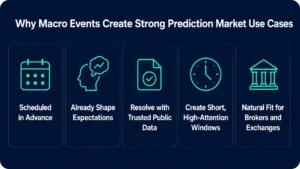
Why macro events create strong prediction market use cases
Macro events are ideal to capitalize on through prediction markets because these events:
- Are scheduled in advance.
- Already influences market expectations
- Resolve against trusted public data
- Create short, high-attention trading windows
- Map naturally to prediction markets for brokers and exchanges
Macro events are the most direct signal of prediction market demand. These events offer a straightforward path to market participation that is both timely and intuitive for platforms with financially engaged clients.
Sports Events Show How Prediction Markets Expand Beyond Finance
Prediction market demand isn’t limited to economics. Sports events often create some of the clearest demand patterns because the audience is broad, the timing is fixed, and the outcome is straightforward. Roland Garros runs from late May into early June, the Indianapolis 500 is scheduled for May 24th, and the UEFA Champions League final is set for May 30th in Budapest.
These events show why prediction markets can scale beyond finance without losing relevance. A platform does not need to force participants into a traditional asset thesis to capture interest. It can create markets around outcomes people already care about. That is one reason sports remain one of the strongest prediction market use cases. The event itself carries the attention. The platform provides the structure.
Sports also broaden the category’s commercial value. A macro market may appeal to an FX trader or a broker audience, whereas a major sports event may attract a different participant profile while still fitting the same product logic. That gives operators more room to expand event categories without relying on one type of client behavior alone.
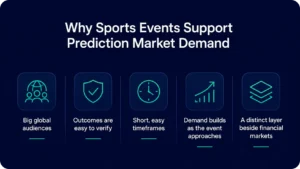
Why sports events support prediction market demand
Sport events are a massive use case for prediction market demand because:
- Global sports events already attract large audiences.
- outcomes are easy to verify
- Timeframes are short and easy to follow.
- Demand builds naturally as the event approaches.
- They create a distinct product layer alongside financial markets.
That makes these events strategic for traffic moments, and part of a broader strategy for building event-based trading around the world’s most-watched outcomes.
Central Bank Meetings Show Why Prediction Markets Fit Brokers
Central bank calendars reinforce the same approach as sports and economic events. The ECB’s next monetary policy meeting is scheduled for June 10th to 11th, and the Bank of England’s next MPC announcement is due June 18th. These are not abstract institutional dates but market moments that already influence FX, rates, and broader sentiment.
Central bank events are especially useful for prediction markets because these events combine credibility with repeatability. A platform can structure markets around whether the ECB holds, cuts, or hikes. It can ask whether the Bank of England changes guidance or keeps policy unchanged. Each event has a fixed time, heavy attention from market participants, and a trusted result source.
This is why prediction markets for brokers are strategic around monetary policy. Central bank meetings already sit close to how broker clients think about volatility, rate expectations, and market direction. Prediction markets add another format for participating in those same moments without forcing everything through a traditional trading model. That is a practical signal of demand, not a theoretical one.
What Open Calendar Windows Mean for Operators
From May 11 onward, the calendar offers a useful cross-section of the events that tend to drive prediction market demand. It includes:
- U.S. inflation and producer price releases
- U.S. retail sales data
- a major Grand Slam tournament
- one of the biggest motorsport events in the world
- Europe’s biggest club football final
- upcoming central bank meetings that affect financial markets globally
This matters because it shows that prediction markets aren’t supported by category hype alone. Instead, these markets are supported by a recurring stream of real-world events that already draw attention. When platforms build around events people are already following, demand becomes easier to understand and easier to capture.
How Operators Should Use This Signal
For exchanges, brokers, and fintech platforms, the takeaway is practical. Prediction markets should be evaluated against real event calendars and real demand windows, not just as a category trend. There are various events throughout the year that show why that approach matters and support stronger market participation:
- short-duration markets with known deadlines
- high-visibility events that already command public attention
- outcomes that can be verified quickly
- Repeated opportunities to bring clients back to the platform
Brokers may see the strongest fit in macro releases and central bank meetings compared to exchanges, which may benefit from combining financial events with sports and crypto milestones. On the other hand, fintech platforms may find demand in more accessible public events that broaden participation without requiring deeper market knowledge.
In every prediction market use case, the same logic applies. Prediction market demand tends to build where attention is already strong, and the market question is easy to understand.
Bottom Line
Prediction market demand is easiest to measure when the global calendar is full of events that people are already watching. CPI, PPI, retail sales, Roland Garros, the Indianapolis 500, the Champions League final, the ECB, and the Bank of England all point to the same conclusion: demand grows when prediction markets are built around visible, time-bound events with clear outcomes.
Prediction markets give operators a way to turn real-world attention into structured market activity. Platforms that understand where demand is likely to build will be better positioned to choose the right event categories, launch with more focus, and capture market interest while the category is still being shaped. If your business is evaluating how prediction markets could fit into your platform, reach out to Shift Markets.
FAQs
-
What is prediction market demand?
-
Why do upcoming global events matter for prediction markets?
-
Which types of events create the strongest prediction market demand?
-
Why are macro releases a strong fit for prediction markets?
-
Why do sports events work well in prediction markets?
-
How should operators use event calendars when planning prediction markets?
Share this article:
Want to learn more?
Let us save you time by walking you through what Shift can do for your business!