

Summarize with AI:
Peer-to-peer prediction market liquidity depends on participants taking opposite sides of the same market at the same time. That can work when volume is deep, balanced, and consistent.
For most brokers and operators launching prediction markets, it creates a problem from day one. Without provider liquidity, flow offsetting, or aggregated liquidity, markets can become thin, spreads can widen, and clients may struggle to trade at fair prices.
Peer-to-peer matching is part of the prediction market model, but it’s not a full liquidity strategy. Operators need a structure that can support pricing, depth, execution, settlement, and risk management even when client activity is uneven.
What is peer-to-peer matching in prediction markets?
Peer-to-peer matching means participants trade directly against each other. One participant takes the yes side of an event, another takes the no side, and the platform matches the two orders when prices align.
For example, one client may believe a team will win a championship, while another believes it will not. If both sides are available at compatible prices, the trade can execute.
This model works best when the market has enough active participants on both sides. Large platforms with deep user activity can use peer-to-peer prediction markets to create real market depth. But for smaller operators, new launches, regional platforms, or focused broker audiences, the model can break down quickly.
The issue is simple: prediction market matching only works well when there is enough volume and enough balance. If one side is missing, the market stops feeling liquid.
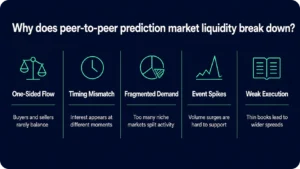
Why does peer-to-peer prediction market liquidity break down?
Peer-to-peer prediction market liquidity breaks down when there are not enough participants on both sides of a market. This creates poor pricing, weak depth, slower execution, and a less reliable trading experience.
The problem becomes more visible in three common situations.
When volume is low
New platforms rarely launch with deep liquidity. A prediction market may have interest, but not enough active participants placing orders at the same time.
That creates wide spreads and limited fill quality. Clients may see a price, try to trade, and find there is not enough depth available. Once that happens repeatedly, the product starts to feel inactive.
For a new prediction market operator, this is a major risk. The client experience can look weak before the product has had time to grow.
When markets are one-sided
Prediction markets often attract directional activity. That is especially true around sports finals, elections, central bank decisions, crypto milestones, and major news events.
If most participants want the same side of a market, peer-to-peer matching struggles. The platform may have demand, but not enough natural counterparties. Prices can move away from reasonable levels, spreads can widen, and clients may struggle to trade.
This is not a small edge case. Directional interest is common in event-based trading.
When the operator does not have large platform scale
Peer-to-peer matching works better when a platform has a large active user base trading the same markets. Most brokers and operators launching prediction markets do not start there.
A broker adding prediction markets to an existing trading platform may have a strong client base, but that does not mean every client will trade the same event at the same time. Without external liquidity support, the broker may struggle to create a consistent experience across markets.
This is why peer-to-peer prediction market liquidity can become a launch blocker. The product may look simple, but the market structure depends heavily on participation.
What is the difference between peer-to-peer matching and liquidity provider support?
Peer-to-peer matching depends on client activity. Liquidity provider support gives operators an additional source of pricing and depth outside their own participant pool.
That difference matters because prediction markets need to work even when natural matching is weak.
Peer-to-peer matching vs. liquidity provider support
| Area | Peer-to-Peer Matching | Liquidity Provider Support |
|---|---|---|
| Pricing quality | Depends on participant balance | More consistent across market conditions |
| Market depth | Thin on new or smaller platforms | Available earlier in the launch cycle |
| Directional event risk | One-sided demand can break the market | Flow can be offset or supported externally |
| Operator control | Limited control over spreads and depth | More control depending on the liquidity model |
| Scale dependency | Needs a large active user base | Can support early-stage and focused platforms |
| Risk management | Relies on natural counterparties | Can be structured through provider support |
| Client experience | Can vary by event and volume | More consistent execution and pricing |
| Back-office visibility | Harder to monitor pricing gaps | Clearer when liquidity structure is defined |
Peer-to-peer matching can still play a role, but the issue is relying on it alone. A stronger model gives the operator more than one path to liquidity.
What liquidity models can support prediction market operators?
Prediction market operators can use several liquidity models depending on their size, risk appetite, market categories, and operating model.
External liquidity providers
External prediction market liquidity providers give operators access to pricing and depth outside their own participant base.
This can help new platforms avoid launching markets that look empty or poorly priced. It also gives brokers a stronger starting point before their own client activity becomes deep enough to support natural matching.
Aggregated liquidity
Aggregated liquidity pulls pricing and depth from multiple sources instead of relying on one provider or one participant pool.
For operators, this can improve pricing consistency, reduce dependence on a single liquidity source, and create stronger coverage across different market categories.
Aggregated liquidity is especially useful when an operator wants to support sports, crypto, politics, macro events, or regional markets with different trading patterns.
Flow offsetting
Flow offsetting lets an operator route client exposure to an external counterparty or liquidity source.
This reduces dependence on peer-to-peer matching and gives the operator a clearer risk model. It can be useful for brokers that want to offer prediction markets without taking on the full risk of making markets directly.
Operator market making
Prediction market market making gives the operator more control over pricing and economics. The operator can provide prices directly, manage spreads, and take a more active role in market depth.
This model can create stronger upside, but it requires more risk management, operational discipline, and pricing capability.
Custom markets with managed liquidity
Custom markets allow operators to create proprietary event markets around their audience, region, or product strategy.
This is attractive for brokers that want differentiation. But custom markets need managed liquidity, clear pricing rules, settlement workflows, and strong operational controls.
What should operators look for in prediction market liquidity providers?
Operators should evaluate prediction market liquidity providers based on their ability to support event-based markets, not only general trading liquidity.
Prediction markets have different requirements from FX, crypto spot, or traditional derivatives. Events are time-bound. Outcomes can be binary. Volume can spike suddenly. Settlement is directly tied to the result of the event.
A strong liquidity partner should support the way prediction markets actually work.
Prediction market specific pricing
Prediction market pricing is different from pricing a currency pair or crypto asset. The price reflects the market’s implied probability of an outcome, not only supply and demand around an asset.
Operators should look for liquidity partners that understand binary outcomes, event timing, and probability-based pricing.
Coverage across market categories
Sports, politics, crypto, macro, and regional events do not behave the same way.
A provider that supports multiple market categories gives operators more room to grow. It also helps prevent the platform from having strong liquidity in one category and weak liquidity in another.
Support during event-driven volume spikes
Major events can drive concentrated trading activity in short windows. A liquidity partner should be able to support those spikes without pricing falling apart or execution quality dropping.
This matters because the biggest prediction market moments are often the most time-sensitive.
Settlement workflow support
Prediction market settlement must be clear before the market opens. The platform needs a defined outcome, a trusted source of truth, and a process for resolving trades.
Liquidity and settlement are closely connected. If pricing and settlement logic are not aligned, operators can create disputes, operational risk, or client confusion.
Fit for the operator’s current scale
Some liquidity partners are built for large institutional volume. Others are better suited to earlier-stage platforms, regional brokers, or focused market launches.
The right provider should support the operator’s current scale while leaving room to grow.
How does aggregated liquidity improve prediction market execution?
Aggregated liquidity improves prediction market execution by giving operators access to more than one source of pricing and depth.
This reduces the risk of depending only on one participant pool or one provider. It can also help tighten spreads, improve fill quality, and support more reliable execution during high-interest events.
For brokers and exchange operators, aggregated liquidity can be especially useful when launching multiple market categories. A platform may have strong activity around crypto events but weaker activity around sports or macro markets. Aggregation can help smooth out those differences and create a more consistent trading experience.
The goal is not only more liquidity. The goal is better prediction market execution across the full product.
When should operators move beyond peer-to-peer matching?
Operators should move beyond peer-to-peer matching when pricing quality, market depth, or client execution depends too heavily on participant volume.
That can happen before launch, during early growth, or when the platform expands into new market categories.
Common signals include:
- Markets have wide spreads
- Clients struggle to fill trades
- One side of the market is consistently thin
- Event volume is highly directional
- Pricing becomes difficult to manage
- Support teams receive complaints about execution
- Operators lack visibility into exposure
- New markets feel inactive at launch
Waiting until clients notice the problem is risky. Liquidity structure should be part of the launch plan, not a fix added after the market feels weak.
How does Shift Markets support peer-to-peer prediction market liquidity?
Shift Markets helps brokers and exchange operators structure peer-to-peer prediction market liquidity with support for external liquidity sourcing, flow offsetting, aggregated liquidity access, and custom market creation.
The goal is to help operators avoid the common problem of relying only on user matching before they have enough volume to support it.
Shift supports operators with:
- External liquidity sourcing
- Aggregated liquidity access
- Flow offsetting options
- Custom market support
- Risk management controls
- Settlement workflow support
- Back-office visibility
- Infrastructure for regulated operators
- Integration with broader trading infrastructure
For operators that already offer crypto, derivatives, or run a white label exchange, prediction market liquidity can be connected into the broader trading environment instead of managed as a separate stack.
This gives brokers a more practical path to launch. They can add prediction markets with a liquidity model designed for real trading conditions, not only ideal market conditions.
Bottom Line
Peer-to-peer prediction market liquidity can work when a platform already has deep, balanced participation. Most operators do not start there.
For brokers and exchanges launching prediction markets, relying only on peer-to-peer matching can create poor pricing, thin markets, weak execution, and a client experience that compares poorly to established platforms. The stronger path is to build liquidity support into the product from the start.
Shift Markets helps operators structure prediction market liquidity in a way that supports launch, execution, settlement, and long-term growth. Request a demo to discuss the right liquidity model for your prediction market platform.
FAQs
-
What is peer-to-peer prediction market liquidity?
-
Why is peer-to-peer matching not enough for prediction markets?
-
What are prediction market liquidity providers?
-
What is aggregated liquidity in prediction markets?
-
What is flow offsetting in prediction markets?
-
How does liquidity affect prediction market pricing?
-
When should operators use external liquidity support?
-
How does Shift Markets support prediction market liquidity?
Share this article:
Want to learn more?
Let us save you time by walking you through what Shift can do for your business!