
Summarize with AI:
SOC 2 for prediction market platforms is becoming a baseline requirement when brokers, exchanges, and fintech operators evaluate infrastructure vendors.
These providers often interact with production systems, reporting, permissions, balances, settlement workflows, or client data. That level of responsibility requires trust, controls, and operational maturity.
SOC 2 is more than a security checkbox before implementing prediction market trading. This framework is a signal that the vendor can support infrastructure where reliability, access control, and operational discipline matter from launch.
Who should care about SOC 2 for prediction market platforms?
SOC 2 matters most to the teams that approve, launch, and operate prediction market infrastructure inside a live business. That includes brokers, exchanges, fintech platforms, product leaders, operations teams, compliance stakeholders, and procurement functions.
This becomes especially relevant once prediction markets move from category interest to real vendor review. At that point, operators need to evaluate launch path, integration, liquidity planning, compliance review, and internal ownership across support and operations.
When those decisions sit inside a broader production environment, vendor controls carry more weight.
What is SOC 2 for prediction market platforms?
SOC 2 is a framework used to evaluate whether a service provider has strong controls around security and operational practices. In practical terms, it helps buyers assess whether a vendor can be trusted inside production systems.
This framework matters for prediction market platforms because the provider may have access to critical business functions. That can include account permissions, reporting, settlement workflows, monitoring, integrations, and back office controls.
In a category where infrastructure needs to support launch, integration, and ongoing platform reliability, a stronger control framework becomes part of the commercial case in addition to the security case.
Why does SOC 2 matter for brokers evaluating prediction market platforms?
Brokers and operators are buying infrastructure that must work inside a live trading environment. As a result, evaluating the right vendor goes far beyond front-end functionality.
In prediction markets, that review is more demanding because the infrastructure needs to support clear market creation, reliable participation, trusted settlement, operational oversight, and the ability to scale without weakening platform control.
This is where SOC 2 becomes a serious factor. It gives procurement, compliance, and operational stakeholders a stronger basis for evaluating the provider. Operators need vendors who can do more than publish general security claims. They need vendors that can show recognized controls that support prediction market trading in production.
What risks do operators take when a prediction market provider lacks SOC 2?
The first risk is hesitation. Internal teams ask more questions, procurement takes longer, and compliance wants stronger evidence. Technical review also becomes more cautious. That drag matters when speed to market is part of the business case.
The second risk is operational uncertainty. Prediction market infrastructure already carries real requirements around liquidity, settlement, reporting, market wording, data reliability, risk controls, and platform stability. Thin liquidity weakens pricing, poor data damages trust, and weak settlement logic creates unnecessary operational and reputational risk. A provider without strong controls adds another layer of uncertainty on top of those existing demands.
The third risk is commercial. A platform may like the opportunity, but still slow down if the vendor looks weak under review. In a category where competitors can move first, procurement friction becomes a business problem.
What should operators evaluate beyond SOC 2?
SOC 2 is a strong signal, but it is not the only one that matters. A provider can pass a control review and still be the wrong fit if launch readiness, platform integration, or operational support are weak.
A stronger vendor review should also look at:
- integration readiness
- reporting and back office controls
- permissions and user management
- liquidity and settlement support
- launch support
- platform fit inside the broader trading environment
- ability to scale as demand grows
A viable prediction market platform needs more than a front-end product. Operators should evaluate whether the vendor can support matching, liquidity, data feeds, risk management, settlement systems, compliance workflows, integrations, reporting, and back office controls from day one.
How does SOC 2 support enterprise prediction market infrastructure?
Enterprise prediction market infrastructure must support trust across security, operations, compliance, and platform reliability. That is why SOC 2 matters.
This framework helps show that the provider operates with structured controls rather than ad hoc processes. For enterprise buyers, this supports a more credible case for production deployment. It also reduces uncertainty during vendor review, which matters in a category that already depends on strong market structure, clean settlement, reliable data, and usable liquidity.
As prediction markets move closer to mainstream trading infrastructure, that standard becomes harder to avoid. A provider may promise launch speed, but enterprise buyers still need confidence that the business can support production systems with appropriate discipline.
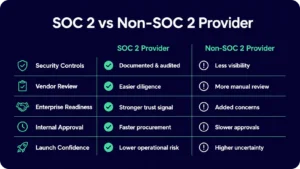
SOC 2 vs. non-SOC 2 providers: what is the difference?
| Area | SOC 2 provider | Non-SOC 2 provider |
|---|---|---|
| Security controls | Reviewed through a recognized framework | Harder to validate beyond vendor claims |
| Vendor diligence | Easier for buyers to assess | More questions during procurement |
| Enterprise readiness | Stronger trust signal for production systems | More uncertainty around operational maturity |
| Internal approvals | Better support for compliance and procurement review | Greater friction in internal signoff |
| Risk perception | Lower concern around control discipline | Higher perceived vendor risk |
| Launch confidence | Stronger case for production deployment | More hesitation, even when the product is attractive |
Shift Markets is SOC 2 compliant and supports operators with prediction market infrastructure built for launch, integration, and long term platform growth. Reach out to our team to choose the right launch path and operational model for your business.
Bottom line
SOC 2 for prediction market platforms is at the center of vendor selection. If prediction markets are becoming real platform infrastructure, providers need to be evaluated like infrastructure vendors. Controls, operational maturity, and enterprise readiness matter just as much as product features.
Shift Markets is SOC 2 compliant and supports operators with prediction market infrastructure built for launch, integration, and long-term platform growth. Reach out to our team to choose the right launch path and operational model for your business.
FAQs
-
What is SOC 2 in simple terms?
-
Do prediction market platforms need SOC 2?
-
Is SOC 2 enough on its own when choosing a provider?
-
Why does SOC 2 matter for brokers and fintech operators?
-
What is the difference between SOC 2 and general security claims?
-
How does SOC 2 affect enterprise adoption?
-
What should be evaluated alongside SOC 2?
Share this article:
Want to learn more?
Let us save you time by walking you through what Shift can do for your business!