
Summarize with AI:
Brokers launch successful platforms when products work inside the same account structure, liquidity model, reporting setup, risk framework, and back-office workflows their teams already use. A broker can add crypto, tokenized assets, or new derivatives, but those products must sit inside the core platform to avoid friction, more manual work, and a weaker client experience.
For brokers evaluating new trading categories, they need to consider how to add new trading categories in a way that feels native to their platform and manageable for their team.
What does native trading platform integration actually mean?
Native trading platform integration means a new product category works inside the broker’s existing platform environment, rather than sitting in a disconnected system running alongside it.
For a broker, that means the new product connects to:
- Client accounts
- KYC and onboarding
- Funding and withdrawals
- Trading access
- Liquidity connections
- Risk controls
- Reporting
- Back-office workflows
- Admin permissions
- Support processes
- Compliance review
A native integration should let the broker add a new product without pushing clients or internal teams into a completely separate journey.
If a broker adds crypto or prediction markets, clients shouldn’t need a separate login, separate wallet flow, separate support process, and separate reporting experience. The new product should feel like part of the broader platform.
Why is category access not enough for brokers anymore?
Category access is the starting point, not the finish line.
A broker may technically be able to offer crypto, prediction markets, tokenized assets, or new derivatives. But that access means little if the product is difficult to manage, disconnected from the main platform, or missing the right operational controls.
New categories often look simple from the outside. A product demo may show the front end working, but brokers still need to answer deeper operational questions:
- How do clients access the product?
- Where do balances sit?
- How does funding work?
- How is liquidity sourced?
- How does risk get monitored?
- What does the back office see?
- How are reports generated?
- How does compliance review activity?
- What happens when support needs to investigate an issue?
If those answers are unclear, the broker isn’t adding a new growth category; it’s adding operational complexity.
Why does native integration matter for multi-asset trading?
Multi-asset trading is now the baseline expectation for modern brokers.
Clients increasingly expect access to more than one product category. They want FX, CFDs, crypto, tokenized assets, and event-based products like prediction markets, all in one place. The opportunity is clear, but so is the operational challenge.
However, the underlying issue is whether brokers can support that asset class without fragmenting the business.
A disconnected setup creates problems quickly. Clients end up moving between systems. Operations teams reconcile activity manually. Compliance loses full visibility. Risk teams can’t see exposure in one place, and support teams struggle to answer basic account questions.
Native integration solves this by making new product categories part of the broker’s existing environment, rather than a parallel business running beside it.
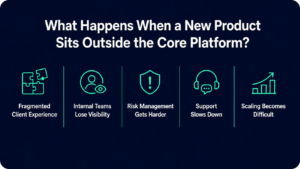
What happens when a new product sits outside the core platform?
When a product isn’t natively integrated, the broker may get category access but lose operational control. That creates a predictable set of problems.
Fragmented client experience
Clients may need a separate login, a separate balance, or a separate funding process. That creates friction and makes the product feel disconnected from the broker’s main platform, which is a real reason for clients to disengage.
Internal teams lose visibility
When trading activity, balances, reports, and client actions sit in separate systems, teams spend more time managing the product than growing it.
Risk management gets harder
Brokers need to understand exposure, trading behavior, liquidity conditions, and account activity in real time. When those signals are split across systems, problems take longer to detect and longer to resolve.
Support slows down
When clients ask about balances, trades, settlement, or account access, the support team needs clean records and clear workflows. Disconnected systems make that harder and slower at every step.
Scaling becomes difficult
What works for a small pilot often breaks when activity increases. A setup that feels manageable at launch can become a real liability as volume grows.
What infrastructure is required for native integration?
Native trading platform integration requires more than a front-end connection. Brokers need to evaluate whether their provider can actually support the full operational layer behind the product and not just the trading interface.
Client setup and account access
This covers account structure that fits the broker’s existing client setup, KYC and onboarding compatibility, and the ability to manage client access without requiring separate environments.
Funding, liquidity, and trading
Includes funding and balance workflows, liquidity connections and routing, and the trading logic that keeps the product functioning reliably at scale.
Risk, compliance, and reporting
This means risk monitoring and exposure controls, back-office reporting, admin permission controls, trade history and audit records, and compliance visibility. All these components need to connect to the main platform rather than sitting outside it.
Settlement, support, and investigation
Covers settlement and reconciliation workflows, support and investigation tools, and the processes that help teams handle client issues without switching between systems.
This is where many new product launches face challenges. The front end can look ready, but if the operational layer isn’t mature enough to support real trading activity, brokers will feel that gap quickly.
How does native integration affect liquidity and risk?
Liquidity and risk are two areas where native integration matters most.
When a broker adds a new category but liquidity sits outside the main trading environment, the platform struggles with pricing, execution quality, and market depth. If risk controls aren’t connected, visibility into exposure becomes limited and that’s a problem that compounds fast.
For crypto trading integration, that means difficulty managing liquidity provider connections, wallet flows, price movements, and 24/7 trading activity. And for derivatives, it means gaps in margin, leverage, collateral, and liquidation logic.
Native integration helps brokers monitor and manage these areas in a way that fits the broader platform. The goal is to give clients access to a category that is tradable, visible, and controllable.
How does native integration improve reporting and back-office control?
Back-office integration is one of the clearest differences between category access and real platform integration.
Brokers need visibility across the full product, including trades, balances, user activity, admin actions, settlement records, liquidity activity, and risk events. Without it, teams end up relying on manual processes or third-party reports that don’t connect to their existing workflows.
A strong back-office setup should allow teams to:
- Review client activity
- Track balances and positions
- Monitor risk
- Export reports
- Investigate disputes
- Manage permissions
- Review operational events
- Support compliance workflows
That visibility is what turns a product launch into an actual product line, something the business can operate, scale, and rely on.
What should brokers look for in a trading platform provider?
Brokers should look for a trading platform provider that can support the full operating model, such as Shift Markets, rather than just access to a product category.
A strong provider should be able to answer clearly:
- How does this product fit into our existing account structure?
- How does onboarding work?
- How do clients fund and trade?
- How is liquidity connected?
- How is risk monitored?
- What does the back office see?
- What reports are available?
- How are permissions managed?
- What compliance workflows are supported?
- How does the product scale as volume grows?
The right provider makes the new category easier to launch and easier to operate. If the integration creates more manual work, more disconnected systems, or more uncertainty, that’s a red flag worth taking seriously.
Native integration vs. category access: what is the difference?
| Area | Category Access Only | Native Trading Platform Integration |
|---|---|---|
| Client experience | Clients may face separate flows, accounts, or systems | Product fits into the existing platform experience |
| Operations | Teams may need manual processes or parallel workflows | Product works inside familiar operational workflows |
| Liquidity | Liquidity may be disconnected from broader platform logic | Liquidity is connected to the trading environment |
| Risk management | Exposure may be harder to monitor across systems | Risk controls fit into the broader control framework |
| Reporting | Reports may be fragmented or delayed | Back-office visibility is easier to manage |
| Compliance | Review may require separate data or manual checks | Compliance workflows can connect to platform activity |
| Support | Teams may struggle to investigate issues quickly | Support teams can access cleaner records and context |
| Scalability | Pilot may work, but scaling can expose gaps | Stronger foundation for growth across product categories |
Category access can help a broker test demand. Native integration helps a broker turn that demand into a real product line.
How does Shift Markets help brokers with native integration?
Shift Markets helps brokers add new trading categories in a way that fits their broader platform strategy.
That matters because brokers are no longer evaluating products in isolation. They want technology infrastructure that can support crypto, FX, CFDs, tokenized assets, prediction markets, and other trading products inside a more unified experience without creating operational gaps in the process.
Shift supports brokers with:
- White-label trading platform infrastructure
- Crypto trading integration
- Prediction market integration
- Liquidity access
- Back-office visibility
- Risk management controls
- Reporting workflows
- Multi-asset trading platform support
- Launch and operational guidance
The goal is to help brokers move faster without creating disconnected systems that weaken their operations. A new category should create growth, not drag. Shift helps brokers bring new products to market with the infrastructure, controls, and workflow support needed to run them properly.
Bottom Line
Native trading platform integration matters because category access alone doesn’t build a strong product. Brokers need new trading categories to work inside their existing account structure, liquidity setup, reporting environment, risk controls, and back-office workflows.
Shift Markets helps brokers launch and integrate new trading categories with infrastructure built for platform growth, operational control, and long-term scalability. Reach out to our team to discuss the right integration path for your business.
Share this article:
Want to learn more?
Let us save you time by walking you through what Shift can do for your business!