
Summarize with AI:
Key Takeaways:
-
Crypto derivatives trading involves contracts based on the price of an underlying cryptocurrency, rather than direct ownership of the asset.
-
The main types of crypto derivatives are futures, perpetual swaps, and options, each with different trading, expiry, margin, and risk mechanics.
-
Traders use crypto derivatives to speculate, hedge existing positions, access leverage, and manage exposure in volatile markets.
-
For exchange operators, launching crypto derivatives requires more than a spot trading engine. It needs margin systems, liquidation logic, risk controls, liquidity access, settlement workflows, and back-office reporting.
Crypto derivatives trading involves financial contracts whose value is based on an underlying cryptocurrency, such as Bitcoin or Ethereum, instead of direct ownership of the asset. The main types of crypto derivatives are futures, perpetual swaps, and options. Traders use them to speculate on price direction, hedge existing positions, manage risk, or gain leveraged exposure to crypto markets.
For exchange operators, crypto derivatives are also one of the most important product categories because derivatives trading often drives higher notional volume, stronger trader activity, and greater platform revenue than spot trading alone.
Why does crypto derivatives trading matter?
The importance of crypto derivatives in the modern financial landscape extends beyond mere trading instruments. These derivatives serve as tools for market stabilization, risk management, and improving overall market efficiency.
Crypto derivatives give traders more ways to manage market exposure. Traders can go long or short, use leverage, hedge existing holdings, and trade price movements without holding the underlying cryptocurrency. This makes derivatives useful for active traders, institutions, and market participants managing risk in volatile crypto markets.
For exchange operators, crypto derivatives trading can expand the platform’s product range and attract more active traders. Derivatives markets tend to generate higher notional volume than spot markets because traders use leverage, manage positions more frequently, and trade both rising and falling markets.
Adding derivatives also changes the infrastructure requirements of an exchange. Operators need margin systems, liquidation logic, funding rate calculations, risk controls, back-office visibility, and access to reliable liquidity.
What are the main types of crypto derivatives?
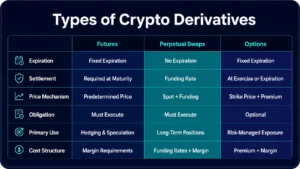
An overview of futures, perpetual swaps, and options: features, uses, and cost structures compared.
Crypto derivatives trading primarily involves three key instruments: futures, perpetual swaps, and options. Each of these types has distinct features and applications, and understanding their specific nuances is important for traders in this market.
Futures
Futures contracts are agreements where traders commit to buying or selling a digital asset at a specific price on a predetermined future date. The core use of these contracts revolves around the anticipation of price fluctuations. Traders use futures to bet on the direction they expect the asset’s price to move.
For instance, if a trader expects the price of an asset to rise, they would enter a long futures contract, agreeing to buy the asset at a set price in the future, hoping to benefit if the market price increases. Conversely, if they expect the price to fall, they might enter a short contract.
Unlike perpetual swaps that have no expiry, futures contracts have a fixed expiration date, at which point the contract must be settled, usually in cash rather than the actual asset being traded. This structured approach allows traders to speculate on and hedge against potential price volatility in the crypto market. However, trading futures involves substantial risk, often amplified by the use of leverage, which can magnify both gains and losses.
Perpetual swaps
Perpetual swaps in the crypto derivatives market offer a unique advantage because they do not expire, unlike traditional futures contracts. This allows traders to hold positions for as long as they wish, providing flexibility to respond to market changes without the transaction costs and potential slippage associated with rolling over futures contracts.
They closely mimic the spot market price through a funding rate mechanism, aligning the perpetual swap price with the underlying asset’s market price. This makes them useful for traders seeking to leverage positions to capitalize on both short-term market fluctuations and longer-term trends without the constraints of predetermined settlement dates.
Options
Cryptocurrency options are financial tools that give traders the right, but not the obligation, to buy with call options or sell with put options a crypto asset at a predetermined strike price before a set expiration date. This flexibility makes them suitable for various strategies, such as hedging or speculation.
The option premium is influenced by the asset’s current market price, the strike price, time until expiration, and the asset’s volatility. It represents the cost for the right to trade the underlying asset and reflects the market’s assessment of the likelihood of the asset reaching the strike price within the given period.
Options in crypto trading offer a more calculated, risk-controlled way to engage in the market, whether for protective hedging or speculative purposes.
How is crypto derivatives trading different from spot trading?
Crypto derivatives trading is different from spot trading because traders are buying and selling contracts based on crypto price movements, not the underlying asset itself. This changes how ownership, leverage, settlement, risk, and infrastructure work.
| Area | Spot Trading | Crypto Derivatives Trading |
|---|---|---|
| Asset ownership | Trader owns the underlying cryptocurrency | Trader trades a contract based on the asset price |
| Leverage | Usually limited or unavailable | Common feature of the product |
| Short exposure | More limited | Traders can go long or short |
| Settlement | Immediate trade execution | At expiry, position close, or ongoing through funding |
| Risk level | Lower product complexity | Higher risk due to leverage and liquidation |
| Infrastructure | Simpler exchange setup | Requires margin, liquidation, risk, and settlement systems |
| Common users | Retail and institutional traders | More active and experienced traders |
What are the main use cases for crypto derivatives trading?
Crypto derivatives trading is used for more than directional speculation. Traders use futures, perpetual swaps, and options to hedge existing positions, manage portfolio risk, access leverage, trade volatility, and act on short-term market views. These use cases make derivatives a major product category for active retail traders, professional traders, and institutions.
Hedging
Traders and institutions use derivatives to reduce exposure to downside risk. For example, a trader holding Bitcoin can open a short futures position to offset potential losses if the price falls.
Directional speculation
Crypto futures trading and perpetual swaps allow traders to take a view on whether an asset price will rise or fall. Leverage can increase potential returns, but it also increases losses.
Arbitrage
Sophisticated traders use crypto derivatives to profit from pricing differences between spot and derivatives markets or between different exchanges.
Income generation
Options sellers can collect premiums by selling call or put options. This strategy is more advanced and depends on market conditions, volatility, and risk controls.
Portfolio management
Institutional traders use crypto derivatives to manage exposure across assets, reduce risk around major events, and adjust positions without selling underlying holdings.
What are the advantages of crypto derivatives trading?
Crypto derivatives trading gives traders and exchange operators more flexibility than spot trading alone. For traders, derivatives open up more ways to manage exposure, trade market direction, and hedge risk. For operators, derivatives can add a higher-volume product category that attracts more active traders.
Traders can go long or short
Crypto derivatives allow traders to take positions in both rising and falling markets. A trader who expects Bitcoin to rise can go long. A trader who expects Bitcoin to fall can go short. This gives traders more ways to act on market views compared with spot trading alone.
Traders can use leverage
Leverage allows traders to control a larger position with less upfront capital. This can make derivatives attractive for active traders who want greater market exposure. It also increases risk, which is why margin controls and liquidation systems are important.
Traders can hedge existing positions
Derivatives can help traders reduce downside risk without selling their underlying crypto holdings. For example, a trader holding Bitcoin can open a short futures position to offset potential losses if the price drops.
Operators can attract more active traders
Crypto derivatives are often used by more experienced and higher-activity traders. For exchange operators, adding futures, perpetual swaps, or options can help expand the platform’s product range and support more frequent trading activity.
Operators can increase product depth
A crypto derivatives platform gives operators more ways to serve retail, professional, and institutional traders. It can also support a broader multi-asset strategy when combined with spot trading, liquidity access, and advanced risk controls.
What are the risks of crypto derivatives trading?
Crypto derivatives trading carries higher risk than spot trading because it often involves leverage, margin, liquidation, and more complex product mechanics. Traders need to understand how each instrument works, and operators need the infrastructure to manage risk properly.
Leverage can amplify losses
Leverage increases exposure, which means gains and losses can move faster than they would in spot trading. A small price move against a leveraged position can lead to a much larger loss relative to the trader’s deposited margin.
Liquidation risk is higher than spot trading
If a trader’s margin falls below the required maintenance level, the platform may automatically close the position. This is called liquidation. Liquidation protects the exchange from losses that exceed available collateral, but it can also create sudden losses for traders.
Funding rates can affect position costs
Perpetual swaps use funding rates to keep contract prices aligned with spot markets. Depending on market conditions, traders may pay or receive funding while holding a position. This can affect profitability, especially for positions held over longer periods.
Pricing and liquidity can change quickly
Crypto derivatives markets can move fast during volatile periods. If liquidity is weak, traders may experience wider spreads, slippage, or poor execution. Operators need reliable liquidity access and risk monitoring to support a stable trading environment.
Product complexity is higher
Futures, perpetual swaps, and options each have different mechanics. Traders need to understand margin, expiry, funding, premiums, settlement, and liquidation before trading. Operators also need clear education, disclosures, and platform controls to support responsible product use.
What infrastructure does a crypto derivatives exchange require?
A crypto derivatives exchange requires more than a spot trading engine. Operators need infrastructure that can manage leveraged positions, margin requirements, liquidation risk, settlement, funding, and reporting in real time.
Margin and collateral management
The platform must track user collateral, calculate margin requirements, and monitor whether each position has enough collateral to remain open.
Liquidation engine
A liquidation engine automatically closes positions when margin falls below the maintenance threshold. This protects the trader, the exchange, and the broader market from losses that exceed available collateral.
Risk engine
A risk engine monitors exposure across users, markets, and instruments. It helps operators identify concentration risk, manage limits, and respond during volatile market conditions.
Funding rate calculation
For perpetual swaps, the platform needs a funding rate mechanism that keeps contract prices aligned with the underlying spot market.
Mark price system
A mark price system helps reduce manipulation risk by using a reference price instead of only the last traded price to calculate unrealized profit and loss and trigger liquidations.
Settlement logic
Futures and options require settlement logic to calculate profit and loss at expiry or exercise. Operators need clear rules for how contracts close and how balances update.
Back-office reporting
Operations, compliance, and risk teams need visibility into open interest, positions, funding payments, liquidations, settlement outcomes, and user activity.
What should operators consider before launching a crypto derivatives platform?
Operators should evaluate the business, technical, compliance, and risk requirements before launching crypto derivatives.
Key questions include:
- Which jurisdictions will the platform serve?
- What leverage limits will apply?
- Which assets and instruments will be offered first?
- How will liquidity be sourced?
- How will margin requirements be calculated?
- What liquidation model will the platform use?
- What reporting will compliance and risk teams need?
- Will derivatives connect to the same account structure as spot trading?
- Will the platform be built internally or launched through a provider?
Should operators build a crypto derivatives exchange or partner with a provider?
Operators can build a crypto derivatives exchange in-house or partner with a platform provider, but the right path depends on timeline, technical resources, compliance requirements, and launch goals.
| Area | Building Independently | Partnering With a Provider |
|---|---|---|
| Time to market | Longer build cycle | Faster launch path |
| Margin engine | Built internally | Supplied by provider |
| Liquidation engine | Built internally | Supplied by provider |
| Risk controls | Built and maintained internally | Supplied and configured with provider support |
| Funding rate system | Built for perpetuals | Included in derivatives infrastructure |
| Compliance workflows | Sourced or built separately | Often supported by platform tooling |
| Liquidity access | Negotiated directly | Provider can support liquidity integration |
| Ongoing maintenance | Fully internal responsibility | Shared with provider |
For most operators, partnering with a crypto derivatives platform provider is the faster path to market. Building may make sense for teams with significant engineering resources, long timelines, and a need for full technical ownership. But for many brokers and exchanges, the infrastructure requirements are too complex to build from scratch without slowing down launch.
How does Shift Markets help operators launch a crypto derivatives exchange?
Shift Markets provides crypto derivatives infrastructure as part of a broader white label exchange platform built for operators managing real client accounts.
The platform supports the core infrastructure required to launch crypto derivatives, including margin management, liquidation systems, risk controls, funding rate calculation, settlement logic, and back-office visibility. For operators already running spot crypto, FX, or multi-asset trading businesses, the derivatives layer can connect into the same platform environment rather than sitting as a disconnected product.
Shift Markets helps operators launch crypto derivatives with the infrastructure, controls, and operational support needed to manage the product from day one.
Bottom Line
Crypto derivatives trading gives traders access to futures, perpetual swaps, and options without directly owning the underlying cryptocurrency. These products support speculation, hedging, leverage, and portfolio management, but they also carry higher risk and require more advanced infrastructure than spot trading.
Shift Markets helps brokers and exchange operators add crypto derivatives through a white label platform built for real trading operations. Request a demo to learn how our team can support your crypto derivatives launch.
FAQs
-
What is crypto derivatives trading?
-
What are the main types of crypto derivatives?
-
How are crypto futures different from perpetual swaps?
-
What is leverage in crypto derivatives trading?
-
What is liquidation in crypto derivatives trading?
-
Is crypto derivatives trading riskier than spot trading?
-
What infrastructure is needed to launch a crypto derivatives exchange?
-
How does Shift Markets support crypto derivatives for operators?
Share this article:
Want to learn more?
Let us save you time by walking you through what Shift can do for your business!