
Summarize with AI:
Shift Markets
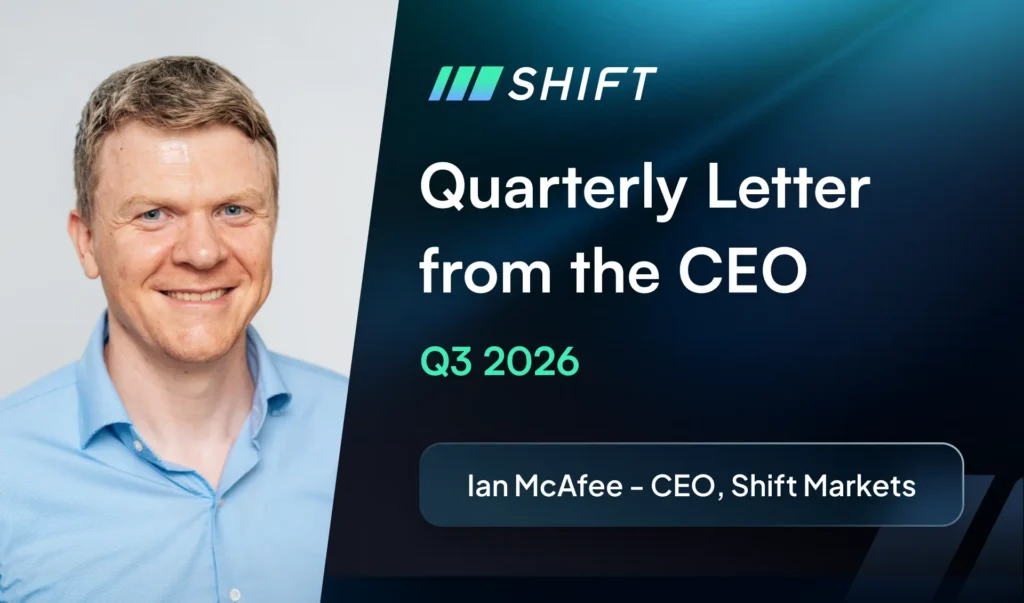
Quarterly Letter from the CEO | Q3 2026
The Best Year CFD Brokers Ever Had
And why the biggest names are spending it on more than CFDs
Ian McAfee, Chief Executive Officer, Shift Markets
To our clients, partners, and the operators building the next generation of trading platforms:
On the morning of October 2, IG told investors that its customers had been busier than a year earlier. First trades were up more than 25 percent. Fees and commissions were up 8 percent. Revenue was down 14 percent, because IG kept less of what came in. Within hours the shares had lost about a quarter of their value.
In the same update, Underdog, the US prediction markets and fantasy sports business IG agreed in July to buy, reported revenue more than double a year earlier.
Last quarter I wrote about the industry players not involved with CFDs, and what Robinhood, Coinbase and Meta had concluded about where traders are going. This one is about the CFD brokers. 2026 has been the strongest year the industry has ever posted, and several of the biggest brokers in it are spending that strength on crypto, equities, futures and prediction markets. They’re spending it to keep the customer when that customer wants to trade something else.
The record
Retail FX and CFD brokers traded a record $33.5 trillion in the first quarter of 2026, nearly double a year earlier, and the results followed. IG’s net trading revenue crossed £1 billion for the first time in 2025. XTB, Plus500 and CMC Markets all reported record periods. CMC now earns most of its income from institutional and B2B platform partnerships rather than direct retail.
Q2 wasn’t as good, mostly because the market wasn’t. Volume slipped about 9 percent from the first-quarter peak, but every one of the top ten brokers finished ahead of where it stood a year earlier.
Then came October 2. IG cut its full-year guidance, and the sell-off took Plus500, CMC and XTB down with it. The traders were still there. What fell was how much of their trading IG kept after hedging, from about 80 percent to 70. It’s just one quarter, but the account held and the non-CFD business doubled.
CFDs pay the bills, but something else brings them in
XTB is the clearest case. In 2019, 80 percent of their new EU clients started with a CFD. By 2025 it was 7 percent. CFDs were still 96 percent of their trading income in the first half of this year.
Plus500’s record half looks similar. Its non-OTC business, which covers US futures, prediction markets and share dealing, grew about 30 percent and brought in 23 percent of new customers. The company added Kalshi event contracts to its US platform in February and sports contracts in June, and clears them itself as a full member of Kalshi’s clearinghouse.
One more Plus500 number: the share of its OTC revenue from customers who have been with the firm more than five years rose from 24 percent in 2022 to 50 percent today. I can’t prove the broader platform is why the older customers stayed, but I’d be surprised if it weren’t part of it.
IG made the biggest move of all. On the combined numbers IG published, prediction markets and fantasy would have been a quarter of 2025 revenue, US revenue more than doubles, and the average customer age drops from about 42 to about 34. The biggest CFD broker in the world agreed to pay up to $1.3 billion for a younger customer trading a product that isn’t a CFD. CMC and Interactive Brokers have made smaller moves in the same direction, from weekend crypto to event contracts inside the trading platform.
These are the biggest names in the industry, and they are on top for a reason. None of them is abandoning its core business, and for the CFD brokers among them, the core business just had its best year. What they’re doing is making sure that when their customer wants to trade something else, it’s already there. They are protecting the account.
What broader platforms show
CFD brokers don’t disclose how money moves between products inside one account. Two American companies come close. Neither is a CFD broker, which is the point. They show what happens when everything is already live on the platform.
Robinhood had a record second quarter, revenue up 32 percent to $1.31 billion. Underneath it, crypto revenue fell 38 percent while event contracts went up more than 10x to $156 million. At the end of September it started rolling out crypto perps to US customers, up to 10x leverage on BTC and ETH, in the same app as the stocks and the event contracts.
Coinbase shows the same thing. Spot crypto volume was down 38 percent, but derivatives grew and prediction markets doubled in a quarter. Coinbase says its strategy is to have enough products that it catches whatever is trending.
The filings prove diversification, not retention. They can’t show whether the person who stopped trading crypto is the one now trading event contracts. I think a lot of it is the same people, because that’s how traders behave. Nobody switches assets. They switch apps.
The trader who opened a CFD account in 2019 has since bought bitcoin, probably touched a perp, and this year had an opinion on a rate decision or a World Cup match that they could have traded.
They don’t see themselves as a CFD trader. They see themselves as a trader, and they go wherever the thing that’s moving can be traded. If that’s your app, the account stays. If it isn’t, you’re bleeding users to whoever has it, and when the flavor of the week cools off they don’t come back, because the other platform has FX and gold too.
CFDs aren’t going away. I’ve heard that prediction every few years for a long time, and the instrument keeps setting records. Gold is still king, and CFDs are the simplest way for a trader outside the US to express a view on the S&P. Not every broker should add every product tomorrow. Some of the fastest-growing names in the rankings got there by being very good at a short list of things in one region.
The CFD business will be fine with older traders. Younger ones are moving to perps, which is the same trade in a different wrapper, and they don’t care which wrapper it comes in. The risk is the customer who leaves between CFD trades, and the one who never cared that it was a CFD in the first place.
The gap is widening
The divide opening in this industry runs between the top ten brokers and everyone else. IG can buy a stock-trading app and a crypto exchange. Plus500 can become a clearing member at Kalshi and stand up a US futures business. Those are balance-sheet moves, available to a handful of firms.
For the next two hundred brokers, running real businesses on a few hundred thousand accounts in one or two regions, the record year was just as good and the options for spending it are far narrower. Those brokers have something Robinhood and Coinbase don’t, which is the local ground game: the licenses, the payment rails, the relationships. That edge holds only as long as the product gap stays small. They can’t acquire their way across the gap, and for most of them outside the US, a regulated event-contracts venue isn’t on the menu at all.
I’ve had something like twenty conversations with these brokers since January, and they follow a pattern. Most of them agree with everything above. What they lack is a way to do it, or a place to start. Prediction markets come up early, and by the time they call, they’ve usually settled whether it’s legal and whether their customers want it. The question we keep getting is where do we get the markets and liquidity. Once they see they don’t have to build that themselves, the call usually ends with a demo request.
A broker that signed with us this year started with crypto perps. Working out how to run a product they’d never run before took longer than anyone planned. Who owns it, how it’s priced, how risk looks at it are questions that touch every department. They are closer to launch now, but the other piece is hiring someone who understands the market, and people who have done this before are in short supply.
I’ve seen the same thing at every broker we’ve launched. The technology is ready a long time before the organization is. You don’t need to be first to any product. You need it live before your customer goes looking elsewhere, and you need someone who owns the next one before the current one ships.
The bet
I made a prediction last quarter for mid-2029. Here’s this quarter’s. By mid-2029, most of the twenty largest retail brokers on the FM Intelligence ranking will offer at least three of these four on one platform: spot crypto, crypto perpetuals, tokenized equities and event contracts.
Of the brokers that don’t get there, I’d expect several to have been acquired by one that did, because the cheapest way to buy accounts in this industry has usually been to buy the broker that was losing them.
A strong CFD business gives you room to invest. The question is where. The leaders spent their best year ever making sure the future wouldn’t depend on a single product. What will your customers want to trade next, and will they be able to do it with you?
Ian
Chief Executive Officer, Shift Markets
Sources
Industry: Q1 per-trader activity; Q2 volumes; Q2 per-account activity.
IG: Annual report coverage; Q3 2026 trading update, 2 October; Share price reaction; Underdog Q3 revenue and acquisition.
XTB: H1 results; Q2 results coverage; Product mix and trading result; First-trade mix, 2019 to 2025.
Plus500: H1 interim results; H1 results presentation; Prediction-markets launch; Sports-contracts launch.
CMC and Interactive Brokers: May coverage; July coverage.
Robinhood: Q2 results; Q2 10-Q.
Coinbase: Q2 results; Q2 10-Q.
Figures are as reported by the cited sources and current as of publication.
Share this article:
Want to learn more?
Let us save you time by walking you through what Shift can do for your business!