
Summarize with AI:
Shift Markets
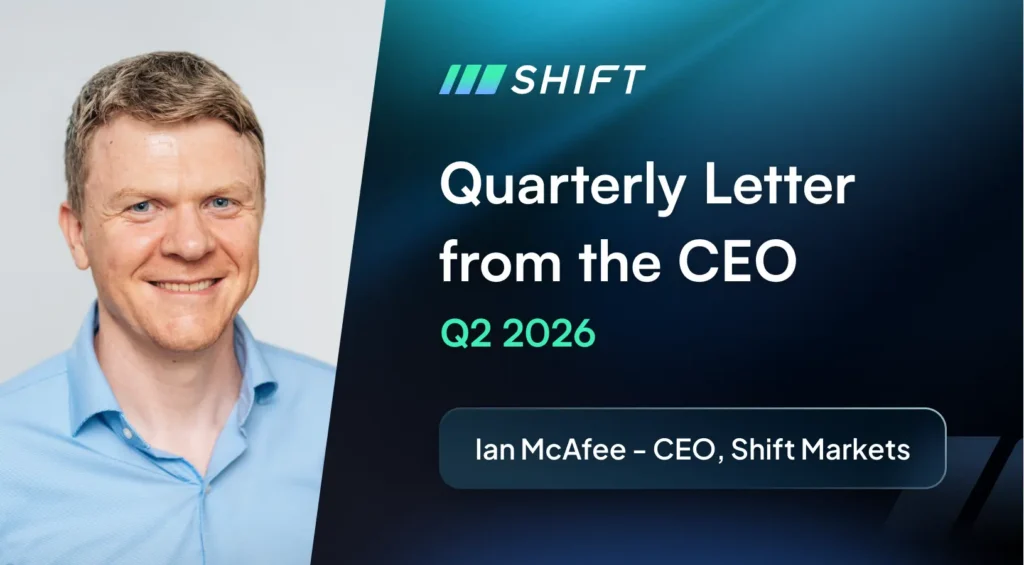
Quarterly Letter from the CEO | Q2 2026
The Convergence Trade
Ian McAfee, Chief Executive Officer, Shift Markets
To our clients, partners, and the operators building the next generation of trading platforms:
I’m starting a habit this quarter. Four times a year, I’ll write down what I’m seeing from where I sit, building the infrastructure that brokers and exchanges run on, and what I think it means for the people running trading businesses. Some quarters will cover several things. This quarter it’s one.
Over the past year and a half, Robinhood, Coinbase, FanDuel together with CME Group, BitMart, and now Meta have all launched or announced prediction markets, four of them since December. I struggle to think of five companies with less in common. A retail brokerage, the largest US crypto exchange, a sportsbook paired with the world’s biggest derivatives operator, a mid-tier crypto venue, and Meta. When companies this different all build the same product in the same window, the product itself usually isn’t the story. The story is what they’ve each concluded about where users are going.
The race that opened
For most of my career, trading platforms competed on coverage. More assets, more instruments, more markets to trade. That race hasn’t ended, but a second one opened over the last eighteen months, and it’s about engagement rather than inventory.
Keyrock and Dune published the most thorough research I’ve seen on the category, and the headline figure is hard to argue with. Monthly notional volume across the major platforms grew from under $100 million in early 2024 to more than $13 billion, a 130-fold increase in under two years.
The curve has kept steepening since that report went to print. June became the first $50 billion month, up 75 percent from May per Artemis data, with the World Cup doing much of the lifting. Polymarket alone handled $6.4 billion in World Cup trades, against $138,000 during the 2022 tournament.
Robinhood offers the cleanest read because it reports publicly. Its customers traded close to 12 billion event contracts in the nine months after launch in March 2025, with about 70 percent arriving in the fourth quarter. By Q4 the business was running at roughly $435 million in annualized revenue, and it became the fastest product line in company history to reach $100 million. Vlad Tenev told investors prediction markets could eventually drive trillions in annual volume. CEOs talk their book, but in this case the numbers underneath support the enthusiasm.
The others each add a piece. Coinbase took prediction markets to all fifty states at the end of January and folded them into what it calls the Everything Exchange, a single interface where a customer holds crypto, equities, derivatives, and event contracts against one balance. FanDuel and CME launched their joint platform in December; sportsbooks and regulated derivatives are colliding. BitMart US went live in June, so the mid-sized venues intend to compete here too. And Meta is building a standalone prediction app called Arena, points-based rather than real money at first, and has reportedly explored working directly with Kalshi and Polymarket. However it lands, that’s distribution across a family of apps used by some three and a half billion people a day.
Capital has voted too. Intercontinental Exchange, the parent of the New York Stock Exchange, committed up to $2 billion to Polymarket at an $8 billion valuation. Kalshi, which raised at $11 billion late last year, is now reportedly discussing a round at $40 billion. Whatever you or I think prediction markets are worth, the people who own the world’s largest exchanges have decided they’re worth owning.
Why this is happening now
The volume explains the rush, but not why platforms this different all want in. My read is that prediction markets change the relationship between a user and a platform. Traditional trading activity follows market cycles, and when volatility compresses, engagement compresses with it. Prediction market activity follows events, and events never stop coming. There’s always a World Cup group stage, a rate decision, or a playoff run on the calendar, which gives these products an engagement rhythm that has nothing to do with whether markets are up or down. Retention tells the same story. Polymarket now holds onto its users better than 85 percent of crypto protocols, on habit rather than incentive programs.
There’s a misconception worth correcting, because I hear it from operators almost weekly: that this is sports betting in a suit. The data says otherwise. On Kalshi, the capital committed to politics, elections, and economics runs about two and a half times the open interest in sports. Sports generates flow because there’s a game every night, but the money that stays parked in these markets is macro money. The fastest-growing categories this year were economics, up roughly 900 percent, and tech and science, up over 1,600 percent. On accuracy, which is what these markets are ultimately for, resolved contracts across the major platforms score around 0.09 on the Brier scale. By the report’s own comparison, that beats polls, expert panels, and even weather models. An instrument that out-forecasts the weather service is not a parlay slip.
For a broker, there’s a more self-interested reason to care. Prediction markets diversify revenue away from a narrow set of volatile instruments. Plenty of operators depend on one or two markets for the bulk of their P&L, and that concentration looks fine right up until volatility compresses. The reverse concentration is just as dangerous, by the way. Platforms that built everything on a single hot event category are now discovering how exposed that leaves them. Breadth cuts risk in both directions, and for a trading business, that makes it a hedge on your own revenue rather than an upsell.
None of this means the regulatory path is settled, and I won’t pretend it is. In the US, prediction markets sit in a live boundary fight between federal derivatives regulation and state gaming regimes. Illinois just imposed the first state tax on sports event contracts and Kalshi sued within days; bipartisan bills targeting sports contracts have been introduced in Congress. The exposure is exactly where you’d expect. Sports accounted for about 85 percent of Kalshi’s notional volume in 2025. It may sound self-serving coming from someone who sells this infrastructure, but I believe regulatory complexity strengthens the case for buying rather than building. An operator navigating this needs jurisdictional routing, configurable market controls, and clean audit trails from day one, and those capabilities take longer to build than the markets themselves. It’s also one more argument for breadth over betting the platform on any single category.
What operators are asking
A year ago, the operators I met wanted to know whether prediction markets were real. Nobody asks me that anymore. The questions now are about fit, about how these markets sit inside a broader platform, how to keep users engaged between market cycles, and how to give people new reasons to return without just listing another instrument.
Under all of it sits a harder question about infrastructure, and the market just answered it twice. In our experience, building an event-contract platform properly, with real liquidity, settlement, resolution, and compliance, runs about eighteen months from a standing start. Coinbase, one of the most capable engineering organizations in this industry, looked at that math and partnered for market access rather than building its own stack. BitMart reached the same conclusion by a different route, licensing turnkey infrastructure and launching some 405 markets under its own brand. Coinbase bought access. BitMart bought technology. And for most operators outside the US, access to a US-regulated venue isn’t on the menu, which makes the technology route the one that matters. When both the biggest US crypto exchange and a mid-tier venue independently decide the smart move is to buy the rails and own the customer experience, it’s worth asking what they both saw.
Liquidity reinforces the point. These order books don’t get deep because retail shows up; they get deep when professional risk desks do. When Kalshi onboarded a major options market maker in 2024, book depth increased roughly thirtyfold and spreads tightened to a few cents. Demand was never the hard part. What’s hard is the liquidity architecture underneath, and most operators shouldn’t attempt it alone.
The wider view
I’ve spent nearly two decades building trading infrastructure for brokers and exchanges, and I’ve watched this arc before, from the inside. Crypto began as an asset serious brokers wouldn’t touch, but some of the biggest early winners came out of FX and CFDs, moving before the category looked respectable. eToro was a CFD broker when it listed bitcoin in 2014. Within a few years crypto had become its growth engine, and last year it carried the company to a Nasdaq listing. Ben Zhou ran Greater China for the FX broker XM for seven years before founding Bybit, which is now among the largest crypto exchanges and has lately been adding CFDs, closing the loop. The traffic ran the other way as well. Coinbase, the biggest crypto-native venue, kept growing by turning itself into a full trading platform. The instrument dissolved into the industry and the specialists converged outward. Prediction markets feel like the same moment, earlier on the curve, and once Meta points its user base at them, the word niche stops applying.
But I want to be precise about what the moment is, because it’s easy to mistake the part for the whole. Prediction markets aren’t the destination. They’re the loudest current example of a convergence running in both directions. Kalshi made the point for me in June when it launched perpetual futures, a traditional trading instrument, and did a billion dollars in notional volume in the first week, a milestone that took its event contracts more than three years to reach. So the prediction-native platforms are adding traditional markets while the trading-native platforms add predictions. Everyone is racing toward the same endpoint from opposite starting points: a platform where a user holds crypto in the morning, tokenized treasuries at lunch, equities in the afternoon, and a position on the evening’s match, all on one login, one balance, one infrastructure layer.
That endpoint is what’s worth building for, and it’s what we build for at Shift. The operators who define the next decade will be the ones whose infrastructure let them assemble the whole picture faster than everyone else, not the ones who happened to add prediction markets first. They’ll have been ready before the moment arrived rather than starting an eighteen-month build when it did.
The bet
The structural prediction underneath all of this is that within three years, prediction market liquidity consolidates into a handful of pools while distribution explodes into thousands of front ends. That’s the pattern in every electronic market. FX runs through a few primary venues and thousands of brokers; equities run through a dozen exchanges and every app on your phone. The thirtyfold depth increase a single market maker brought to Kalshi tells you liquidity wants to concentrate. Meta pointing markets at three and a half billion people tells you distribution wants to scatter. The interesting businesses of the next cycle sit in between, routing one to the other.
So here’s a test I’d invite you to run against this letter in mid-2029. Of the five names I opened with (Robinhood, Coinbase, FanDuel and CME, BitMart, and Meta), I’d bet at most two still operate prediction markets as a distinct product line, with its own app, its own tab, its own line in the earnings deck. For the rest, it will have dissolved into the platform, one instrument among many on one balance, which is the outcome that matters. The companies that launched a prediction market will have gotten a press cycle. The companies that built for convergence will have gotten the customer.
Ian
Chief Executive Officer, Shift Markets
Sources
Category volume, open interest, retention, accuracy (Brier), Kalshi sports volume share, ICE/Polymarket and Kalshi funding, and market-maker liquidity figures: Keyrock & Dune, “Prediction Markets: The Next Frontier of Financial Markets” (December 2025). June 2026 volume and World Cup trading figures: Artemis data, as reported by Finance Magnates, July 2026. Robinhood contract and revenue figures: Robinhood Q3 2025 results and Q4 2025 earnings disclosures. Coinbase launch and “Everything Exchange”: Coinbase company communications, January 2026. FanDuel/CME: company announcements, December 2025. BitMart US launch: company announcement, June 12, 2026. Meta “Arena” and reported Kalshi/Polymarket discussions: The New York Times, NPR, and Reuters, June 2026. Kalshi perpetual futures, reported $40B round, and Illinois litigation: public reporting, March–June 2026. eToro bitcoin launch (2014) and Nasdaq listing (May 2025): public company history. Bybit founding and Ben Zhou’s XM background: public reporting and company biographies. Figures are as reported by the cited sources and current as of publication.
Share this article:
Want to learn more?
Let us save you time by walking you through what Shift can do for your business!