Summarize with AI:
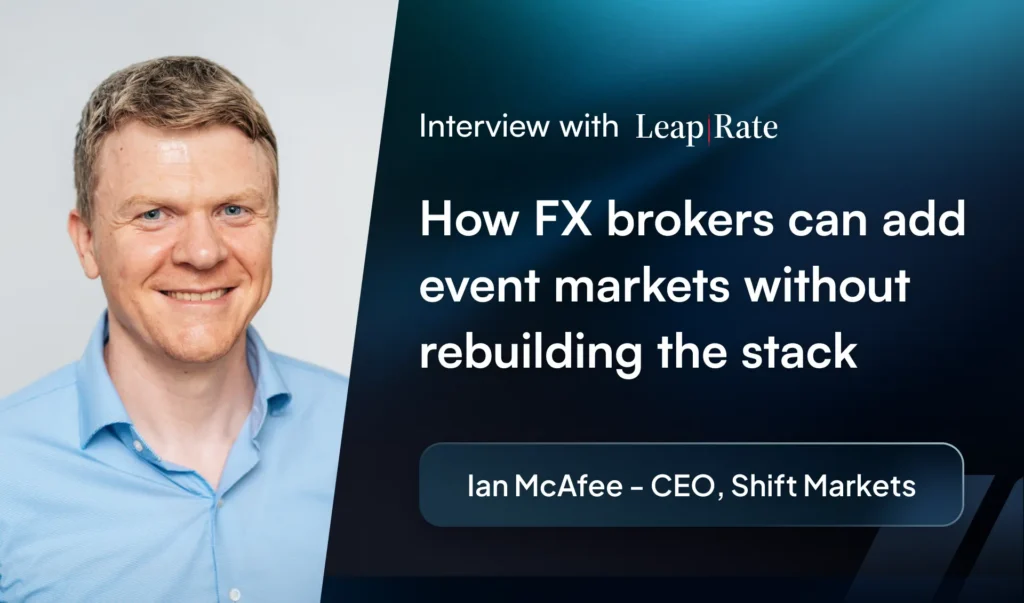
Our CEO Ian McAfee spoke with LeapRate about a question that now comes up on almost every broker call we take: how an FX or CFD broker adds event contracts without rebuilding its platform. His answer is that most of the existing stack carries over, and what a broker adds is a markets layer with liquidity from established venues.
Below are the main points. The full interview is on LeapRate.
Why are brokers looking at event markets now?
Ian’s view is that broker clients already trade event markets on other platforms, and brokers want that activity back where they hold the account. For years brokers competed on how many symbols they listed. The competition has moved to what clients can trade, and prediction markets are the clearest example.
What carries over, and what does a broker add?
Most of the existing stack stays as it is, and clients trade events from the login they already use.
- What carries over: accounts, onboarding and KYC, balances, funding rails and the back office.
- What gets added: pricing and matching for event contracts, settlement logic that pays out when an event resolves, and risk controls for the product.
Ian put it in one line: “Keep the traders, license the infrastructure.”
Where does the liquidity come from?
A broker should not have to build an order book from scratch for a product it has never run. The model Ian describes is the one FX brokers already know: connect to a small number of upstream sources, route flow to them, apply the broker’s own margins and risk limits, and keep the client on the broker’s platform. Shift Markets connects brokers to prediction market liquidity from Polymarket and leading venues, delivered as a white-label module inside the broker’s own app.
In Ian’s experience, the connectivity is rarely what slows things down. The harder decisions are how much risk the broker keeps versus passes upstream, and who internally owns pricing an event book.
What should a broker settle before going live?
Ian names three decisions, and someone inside the broker has to own all three:
- Risk policy: the house model, how much sits in a B-book, the exposure limit per event and where to hedge.
- Settlement: a reliable data source for every market and a documented process for disputed outcomes.
- Classification: event contracts are treated as a financial product in some jurisdictions and closer to gaming in others, so local counsel is needed in each market.
How does a broker know the product is working?
Ian suggests four measures for a first rollout:
- Adoption: the share of existing clients who place at least one event trade.
- Repeat activity: trades per active user and how often they come back.
- House economics: net margin after hedging and revenue per active user.
- The wider account: whether clients who trade events also fund more and trade other products more often.
Bottom Line
An FX or CFD broker can add prediction markets without rebuilding its platform. Accounts, KYC and balances carry over, liquidity comes from established venues, and the real work is deciding on risk, settlement and classification before going live. Read the full interview on LeapRate.
To see how a prediction markets module fits your platform, reach out to our team to request a demo.
Share this article:
Want to learn more?
Let us save you time by walking you through what Shift can do for your business!